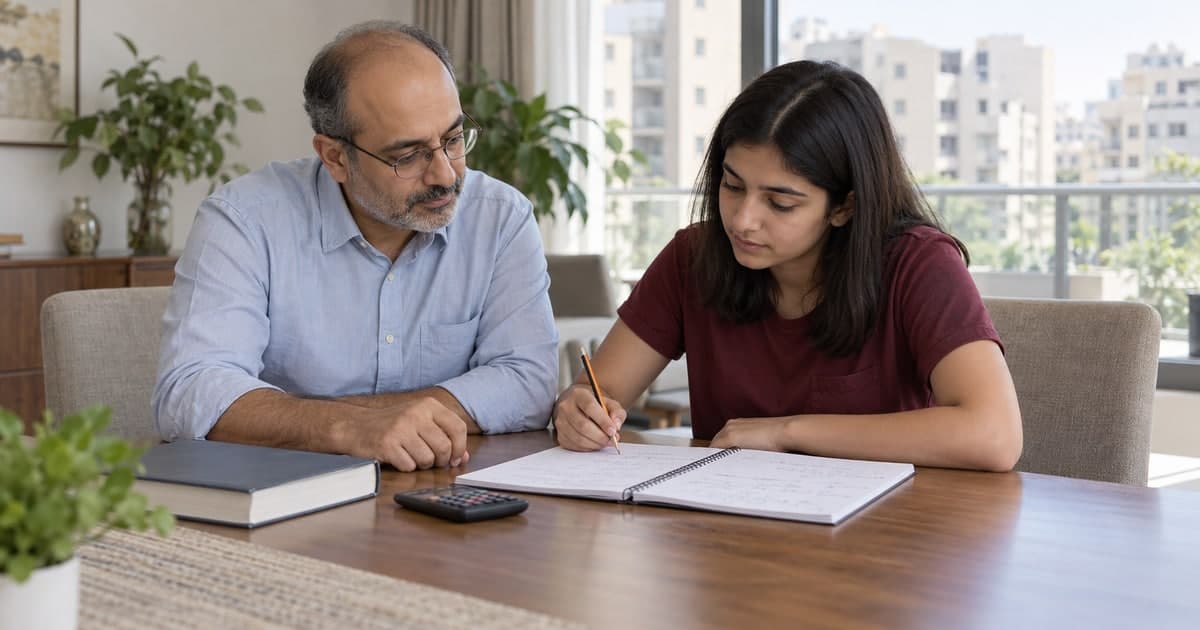
The right biology tutor in Dubai should help a student use knowledge—not only remember more of it. When booking home tuition, identify whether the main difficulty is understanding a process, interpreting an unfamiliar diagram or dataset, applying ideas to a new situation, or writing an answer that addresses the question.
Start with the student's exact curriculum and level, then ask for a lesson plan that addresses their own work. GetYourTutors and Math & Science Tutor advertise biology tuition at Dubai homes. Their pages establish a public offer, not verified qualifications, a guaranteed grade or confirmed availability through Bestimate.
Match the course before comparing biology tutors
A request for “Year 11 biology” does not tell a tutor whether the student takes a separate biology qualification, biology within combined science, or another school curriculum. Provide the awarding body, qualification code, examination year and any applicable level or tier.
For example, Cambridge IGCSE Biology 0610 lists its 2026–2028 syllabus by examination year. Use the course the school has actually entered, not an assumed equivalent. The GCSE and IGCSE tutoring guide can help clarify that wider qualification choice.
IB Diploma families should specify SL or HL and the assessment year. The current IB Biology overview describes an interconnected curriculum, a practical programme and an independent scientific investigation. Older paper references or resources may not match the student's course. Ask the tutor to identify the current specification they will follow.
For AS/A-Level, send the full qualification and component details. Do not buy a course simply labelled “A-Level biology” without checking the awarding body and route. The existing A-Level maths and science guide explains the route-level checks without repeating them here.
Look beyond memorisation: four different learning needs
Revision cards can be useful, but a pile of completed cards does not show whether the student can handle a new question. Use a small sample of permitted marked work to discuss the type of support needed.
| Observed difficulty | A useful teaching focus | What to look for afterwards |
|---|---|---|
| Remembers terms but mixes up a process | Sequencing, cause and effect, and links between structures and functions | Explains the process in their own words, with a clear diagram where useful |
| Struggles with an unfamiliar graph or experiment | Reading axes and units, identifying patterns and linking claims to evidence | Uses the supplied data rather than reciting a memorised topic summary |
| Writes a lot but does not answer the task | Interpreting the command, selecting relevant detail and constructing a logical answer | Explains why each sentence is relevant to this particular question |
| Understands feedback but repeats errors later | Short independent practice, correction and a later fresh question | Applies the idea with less prompting after the lesson has ended |
These are examples to discuss, not labels to attach to a child. Ask the tutor to explain the evidence behind their proposed focus. If a student understands the biology but struggles with academic English, the plan should recognise that distinction rather than simply add more content to memorise.
Evaluate a first lesson using a fresh task
Bring a manageable piece of work with the student's original answer and feedback. Ask the tutor to explore the reasoning, teach one priority and give a different example afterwards. The student should have time to think and explain, not spend the entire session copying polished notes.
For a data question, a useful check is whether the student can distinguish an observation from an explanation and recognise what the evidence does not establish. For a written response, ask them to identify the question's demand and justify the detail they include. These are more informative goals than finishing a fixed number of pages.
Agree what will be practised independently and when progress will be reviewed. A short update can state the skill covered, what the student now does without help and the next priority. Avoid treating one successful familiar question as proof of a guaranteed examination grade.

Practical skills and investigations: define the boundaries
Biology is not just a written subject. However, a home tutor can discuss experimental design, interpret existing data and use diagrams or appropriate simulations without turning the dining room into a laboratory. Required school practical experiences and supervised assessments remain the school's or examination centre's responsibility.
Do not arrange improvised microbial culture, dissection or handling of biological samples as a normal home-lesson activity. Ask the school about an appropriate setting and its approved arrangements if a practical requirement is involved. A tutor's ability to explain a method is not proof that they can provide the required facility.
For an IB investigation or other assessed work, agree the permitted feedback boundaries with the school. The tutor must not invent measurements, complete the analysis or write the submission for the student. Discussions should develop understanding while preserving the student's independent work.
Compare the total lesson package, not only the rate
A fair comparison uses the same course, one-to-one home format, live teaching time and feedback expectations. Ask whether written-answer marking happens during the lesson or between visits, and whether that time is included. “Support included” is too vague if nobody has defined the amount or turnaround.
- Teaching: named tutor, exact course expertise, session minutes and planned focus.
- Feedback: amount of independent work, marking arrangements and brief progress updates.
- Visit charges: travel, parking, registration and any applicable VAT, with the final payable amount in AED.
- Commitment: package size, expiry, cancellation notice, rescheduling, refunds and replacement-tutor policy.
- Separate items: textbooks, examination fees, laboratory access and supervised assessment components unless explicitly and validly arranged.
The Dubai private tutoring cost guide provides broader pricing and lesson-format context. This page does not treat those general benchmarks as a verified biology-specialist average. Request a quote for your actual scope before committing to a recurring plan.
Home tutoring budget guide
Choose lessons per week, lesson length and a 4- or 8-week planning period in the home tutoring budget guide. The published hourly references are AED 200–375: one 60-minute lesson each week for 4 weeks gives a lesson-fee planning range of AED 800–1,500.
Planning reference from published one-to-one lesson fees, not a quote or a Dubai-wide average. Confirm your subject, tutor, travel, VAT and package terms before booking. Different VAT/travel inclusions mean this is not a final all-inclusive comparison. Assessment, extra materials and exam entry fees excluded. Source details are in the calculator’s expandable methodology.
For Dubai home visits, confirm the area and time window, building or community entry and parking privately. Keep lessons in a shared study area with a responsible adult available for a minor. Check the tutor's identity, relevant experience, safeguarding arrangements and authorisation where required. A broad provider listing is not a substitute for checking the individual assigned.
Write a biology request that avoids a generic match
State the curriculum, qualification code, level, examination year and priority topics. Describe a specific need such as “understands the chapter but struggles to interpret unfamiliar graphs” or “needs feedback on structured explanations”. Include your home area, available times, preferred visit length and whether marking is required between sessions.
Use the Science Tutoring service and specify biology in the request. If sharing work, remove personal identifiers and candidate numbers, and use only material you are permitted to share. Never provide school passwords or confidential upcoming papers. Assess each response for course fit and terms, not claims of guaranteed results.
Compare Biology Tutor Quotes. Confirm the curriculum, home-visit coverage, fees and package terms before booking.
Frequently asked questions
Does biology tuition mainly involve memorising notes?
No. Depending on the student's needs, useful tuition can connect concepts, interpret evidence and improve the relevance of written answers. Ask the tutor which issue appears in the student's own work.
Can a general science tutor teach IB HL biology?
Possibly, but verify specific, recent experience with the current course and level. General science experience alone does not establish advanced biology expertise.
Can a home tutor provide the required biology practicals?
Do not assume so. Home lessons can support practical reasoning, but required facilities and supervised components should be confirmed with the school or examination centre.
What should we check after a trial lesson?
Look for a clear priority, an understandable explanation and a fresh task the student attempts independently. Agree a realistic follow-up activity and a review point.
Can a biology tutor edit an assessed investigation?
Ask the school what feedback is permitted. The student must retain ownership of the work; the tutor should not produce the analysis, invent data or write the assessed submission.
Sources and review notes
Reviewed 24 October 2026 by Bestimate Editorial Team. Official references: Cambridge IGCSE Biology 0610 and the IB Diploma Biology overview linked above. Local home-tuition scope checked on GetYourTutors and Math & Science Tutor. These checks do not independently verify provider credentials, grades, available slots or Bestimate supply. Confirm current assessment requirements with the student's school.