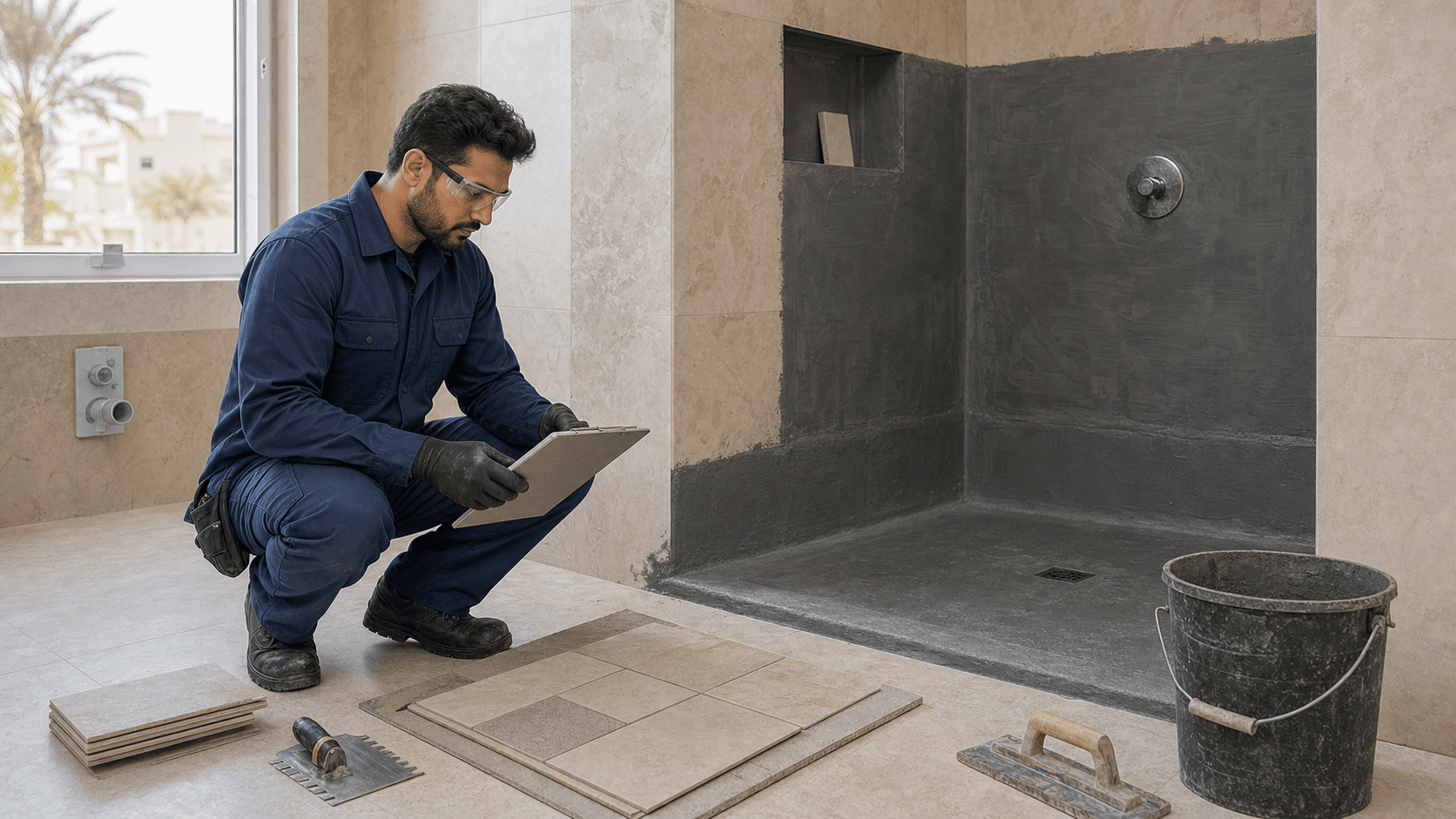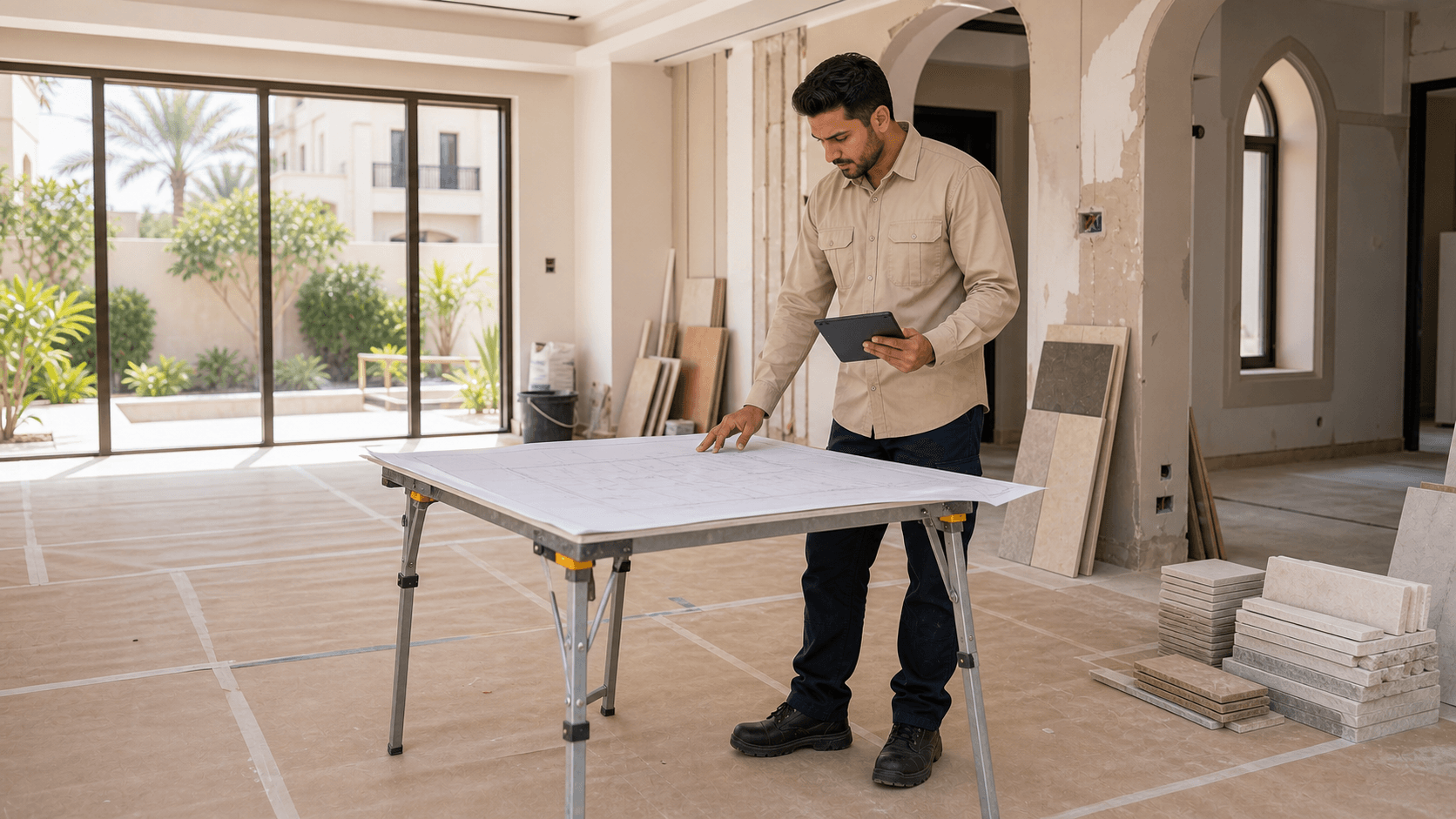
- Approvals are commonly required when renovation work removes or adds walls, relocates plumbing or electrical points, remodels wet areas, alters a false ceiling near fire or MEP systems, or encloses a balcony.
- Paint, furniture and like-for-like flooring overlays usually need no authority permit — but many buildings still require a simple NOC first; confirm before signing.
- Budget wide: NOC fees commonly AED 0–5,000, refundable deposits AED 2,000–20,000, drawings AED 2,500–15,000, authority permit fees roughly AED 200–10,000.
- Unapproved work risks stop-work and fines of up to AED 50,000 under Dubai's construction works law, plus rework at handover or resale.
Renovation approvals in Dubai are confusing because up to three layers can apply to one job: your building or community's NOC, a developer design approval, and a government permit from Dubai Municipality, Trakhees or the DDA depending on the zone. This guide covers one decision — which approvals commonly apply to your scope and what to budget for them — using official portals and dated public guides checked on 4 August 2026.
It pairs with the Dubai renovation services guide for choosing the right service. The figures below are indicative planning ranges, not quotes, fee schedules or legal advice.
Which renovation works commonly need approval — and which do not
There is no single citywide list: the authority depends on the zone, and buildings add their own rules on top. The pattern below holds across most Dubai homes — confirm your exact scope with building management before work is priced.
| Planned work | Building or developer NOC | Authority permit | Watch for |
|---|---|---|---|
| Painting and redecorating, same layout | Often none, or a light access NOC | Not typically required | Work hours, lift protection and gate passes still apply |
| Flooring overlay, no level or screed change | Commonly a light NOC | Not typically required | Touching wet-area waterproofing moves this into permit territory |
| Cabinet or wardrobe replacement, same positions | Commonly a light NOC | Not typically required | New connections or a moved sink change the answer |
| Removing or adding partition walls | Yes | Commonly required | Structural or load-bearing walls need an engineer |
| Relocating plumbing or electrical points; wet-area remodels | Yes | Commonly required | Ask who handles utility coordination and testing |
| False ceiling changes | Yes | Commonly, where MEP or fire systems are affected | Sprinkler and detector moves bring fire-safety review |
| Balcony enclosure, façade or external changes | Yes — developer design approval | Yes | Often restricted or refused |
| Extensions, pools, structural openings | Yes | Yes — full permit route with a consultant | Some zones also ask for structural or geotechnical reports |
Two surprises catch people. First, "no permit" work still needs building paperwork — insurance, gate passes, work hours — even for painting. Second, electrical scope escalates fast: new circuits, distribution board changes or extra load can involve utility coordination, so get who-handles-what in writing before you sign.
Who approves what: Dubai Municipality vs Trakhees vs DDA vs your developer
Dubai does not have one permit office — the government authority depends on the development your building sits in:
| Approver | Where it commonly applies | What it issues | Publicly sourced notes (checked Aug 2026) |
|---|---|---|---|
| Dubai Municipality | Most mainland Dubai buildings and villas | Building and modification permits plus completion certificates | Official procedures cover villas, multi-storey and public buildings; applications run through licensed consultants and contractors |
| Trakhees (PCFC) | Palm Jumeirah, JAFZA and other PCFC-regulated zones | Modification NOC and permit, then a Modification Completion Certificate | Fees listed "as per project specification"; submissions via the Trakhees online portal |
| Dubai Development Authority (DDA) | DDA-regulated free-zone developments | Fit-out permit requested by the contractor, plus a completion certificate | AED 0.90 per sq ft (min AED 200, max AED 10,000) plus AED 20 admin fees; listed delivery 2 working days; valid 6 months; Civil Defence completion certificate required before the fit-out completion certificate |
| Developer / community management | Master communities by Emaar, Nakheel, DAMAC, Meraas and others | Modification or fit-out NOC, contractor entry permits, deposit inspection | Commonly required before any authority permit — compared below |
| Building management / owners association | Individual towers, including inside master communities | Access NOC and site rules, even for cosmetic work | Small administrative fees and refundable deposits are common |
The sequence runs: community or building NOC first, then the authority permit, then completion steps once work finishes. Your contractor normally identifies the authority and applies — but the quote should state who arranges and pays for each step.
Developer NOC comparison: Emaar, Nakheel, DAMAC and Meraas
Developer NOCs are the least standardised part of the process. Where no official fee schedule is published, budget from the wide range and confirm on the portal for your community.
| Developer | Where to apply | Typical documents | Indicative fees and deposits (public sources) |
|---|---|---|---|
| Emaar | Emaar Community Management portal — home modifications request | Title deed, owner ID, contractor licence and insurance, scope, drawings, deposit cheque | No official public schedule; 2026 guides indicate fees about AED 1,000–5,000 and deposits AED 5,000–20,000 — confirm on the portal |
| Nakheel | Nakheel community management; in PCFC zones such as Palm Jumeirah a separate Trakhees permit follows | Similar set plus undertaking letters; structural works need consultant drawings | No official schedule; 2026 guides indicate about AED 2,000–5,000 plus an AED 5,000–20,000 refundable deposit — varies, confirm |
| DAMAC | DAMAC Living app — "NOC for Fit Out/Alterations" request | Contractor details and drawings via the portal before work starts | No official schedule; a 2026 guide indicates roughly AED 1,000–2,500 — varies, confirm in-app |
| Meraas | Meraas community management / RealConnect | Official FAQ list: signed scope letter, appointment and undertaking letters, title deed, IDs, existing and proposed plans | Official FAQ: minor NOCs free in 2–3 working days; major NOCs 10 working days with administrative fees — amounts not published |
Across developers, internal painting and regular maintenance are widely treated as no-NOC or light-NOC work, while anything visible from outside — façade, roof, balconies, pools — needs design approval and is commonly restricted. Deposits are refunded only after a final inspection, so keep gate passes and disposal receipts.
What renovation approvals typically cost in 2026
| Cost item | Indicative 2026 planning range | Notes |
|---|---|---|
| Building or community NOC, minor works | AED 0–1,500 | Meraas publishes minor NOCs as free; towers commonly charge small admin fees |
| Developer NOC fee, major works | AED 1,000–5,000 | Secondary 2026 guides across the four developers; no official schedules |
| Refundable security deposit | AED 2,000–20,000 | Tower scopes low, villa and external scopes high; refunded after inspection |
| Authority permit fee | AED 200–10,000 | DDA: AED 0.90 per sq ft, min AED 200, max AED 10,000 (official); Dubai Municipality commonly AED 500–3,500 per 2026 guides; Trakhees per project specification |
| Drawings, engineering and submissions | AED 2,500–15,000 | As-built plus proposed drawings, MEP details and submissions; structural scopes cost more |
| Site protection, waste and debris disposal | AED 300–2,500 | Usually in the contractor's quote; debris clearance is a condition of the deposit refund |
As checked on 4 August 2026, only the DDA publishes a full fee formula; municipality, Trakhees and developer charges vary with scope and floor area, so the honest ranges are wide. Drawings move the total most: a cosmetic scope can clear approvals for a few hundred dirhams, while a layout-change apartment commonly lands around AED 4,000–20,000 before the refundable deposit. These are indicative planning ranges, not quotes — your actual cost depends on the written scope, property, zone and who prepares the drawings.
For the construction budget itself, see the kitchen, bathroom, apartment and villa renovation cost guides, or run an early number through the renovation cost calculator.
Get quotes that state who handles approvals: describe your renovation once, then compare several Dubai contractor quotes for free on scope, price and who arranges the NOC, drawings and permit.
Compare renovation quotes in Dubai or review home renovation in Dubai.
How long approvals take
- Building or community NOC: same-day to about two weeks — Meraas publishes 2–3 working days for minor and 10 for major NOCs; 2026 guides indicate 5–15 days for Emaar and 7–15 for Nakheel.
- Authority permit: the DDA lists 2 working days for a complete application; 2026 guides put first-submission municipality reviews around 3–10 working days and Trakhees around 7–14, with each revision round adding 5–10 days.
- End to end: roughly 3–5 weeks for a standard layout-change scope; longer for structural or external works.
- Validity: permits expire — the DDA fit-out permit is valid 6 months — so time the application to the real start date.
The usual delay is not the authority but an incomplete drawing set; a quote that names drawings, submission and revisions as a line item clears faster.
Step-by-step: getting a Dubai renovation approved
- Fix the scope in writing and collect quotes stating who arranges and pays for NOC, drawings, permit and completion.
- Ask building or community management which approvals apply — the same work can be NOC-only in one tower and permit-level next door.
- Appoint a licensed, insured contractor; add an engineering consultant for structural or submission-heavy scopes.
- Prepare the documents: title deed or Ejari, IDs, appointment and undertaking letters, existing and proposed drawings.
- Apply for the developer or building NOC, pay the fee and deposit, and wait for it before any demolition.
- Have the contractor apply for the authority permit for your zone, attaching the NOC and drawings.
- Work under the permit conditions — approved hours, site protection, required inspections.
- Close out: completion certificate where applicable, debris cleared, deposit refund inspection booked.
The cost of skipping approvals
Dubai's construction works law — Local Order No. 3 of 1999 — requires a permit before works that change the features of any land or property, and provides for a fine of up to AED 50,000, doubled upon a subsequent violation, alongside stop-work instructions that can freeze a half-demolished home.
- Deposit and access: building management can suspend contractor access mid-job and deduct from the deposit for damage or debris.
- Handover: unapproved modifications commonly surface at the deposit-release inspection; regularising later means as-built drawings, re-inspection and sometimes partial demolition.
- Resale: buyers, banks and inspectors compare the unit against approved plans, so unapproved works can complicate a sale until resolved.
- Liability: if a leak or fault traces back to unapproved plumbing or wiring, expect hard questions from insurers and building management.
None of this is legal advice — where an approval question is disputed, raise it in writing with building management or the relevant authority.
Sources checked
Official pages reviewed on 4 August 2026: the DDA fit-out permit service page, Dubai Municipality building permit procedures, the Trakhees modification permit service on the PCFC portal, the Meraas property FAQs, the DAMAC Living app listing, and Local Order No. 3 of 1999 on the Dubai legislation portal. Fee and timeline ranges without an official schedule come from dated 2026 fit-out guides by First Unicorn Interiors, Dar Al Naseeb and ReviveHub — commercial consultancies whose figures are indicative and not endorsements.
Reviewed 4 August 2026. Approval requirements, fees and timelines change and differ by building, community and zone; the figures above are indicative planning ranges from the public sources cited, not quotes, fee schedules or legal advice. Bestimate does not process permits and does not verify contractor licences or approvals — confirm current requirements with your building management and the relevant authority before starting work.
Frequently asked questions
Do I need a permit to renovate an apartment in Dubai?
It depends on the scope, not the property. Cosmetic work usually needs no authority permit, though your building commonly still wants an NOC. Removing walls, relocating plumbing or electrical points, remodelling wet areas or altering a false ceiling near MEP and fire systems commonly needs both.
Do I need an NOC just to paint or change flooring?
Often yes, but a light one covering contractor insurance, work hours and lift access. Meraas, for example, publishes minor modification NOCs as free with a 2–3 working day turnaround. Confirm with your building before booking a start date.
How much do renovation approvals cost in Dubai?
A light NOC-only scope commonly costs AED 0–1,500. A layout-change scope commonly lands around AED 4,000–20,000 across NOC fee, drawings and permit, plus a refundable deposit of AED 2,000–20,000. Only the DDA publishes a full formula — AED 0.90 per sq ft, minimum AED 200, maximum AED 10,000 — so treat other figures as ranges to confirm.
Who arranges the permit — the owner or the contractor?
Commonly the contractor or consultant applies to the authority — the DDA lists the contractor as the requester — while the owner signs the NOC request and undertaking letters and pays the deposit. Make the split explicit in the quote.
How long does a developer NOC take?
Plan one to three weeks before site start: Meraas publishes 2–3 working days for minor and 10 for major NOCs, and 2026 guides indicate about 5–15 days for Emaar and 7–15 for Nakheel. The authority permit follows the NOC.
What happens if I renovate without a permit or NOC?
Dubai's construction works law provides for fines of up to AED 50,000, doubled on repeat, plus stop-work instructions. You also risk suspended contractor access, deposit deductions, rework at the deposit-release inspection and friction at resale.
Does electrical work in a renovation involve DEWA?
A like-for-like fixture swap normally does not. New circuits, distribution board changes, load increases or an EV charger can require utility and building coordination — ask the contractor to state in the quote who handles approvals, testing and certification for the electrical scope.