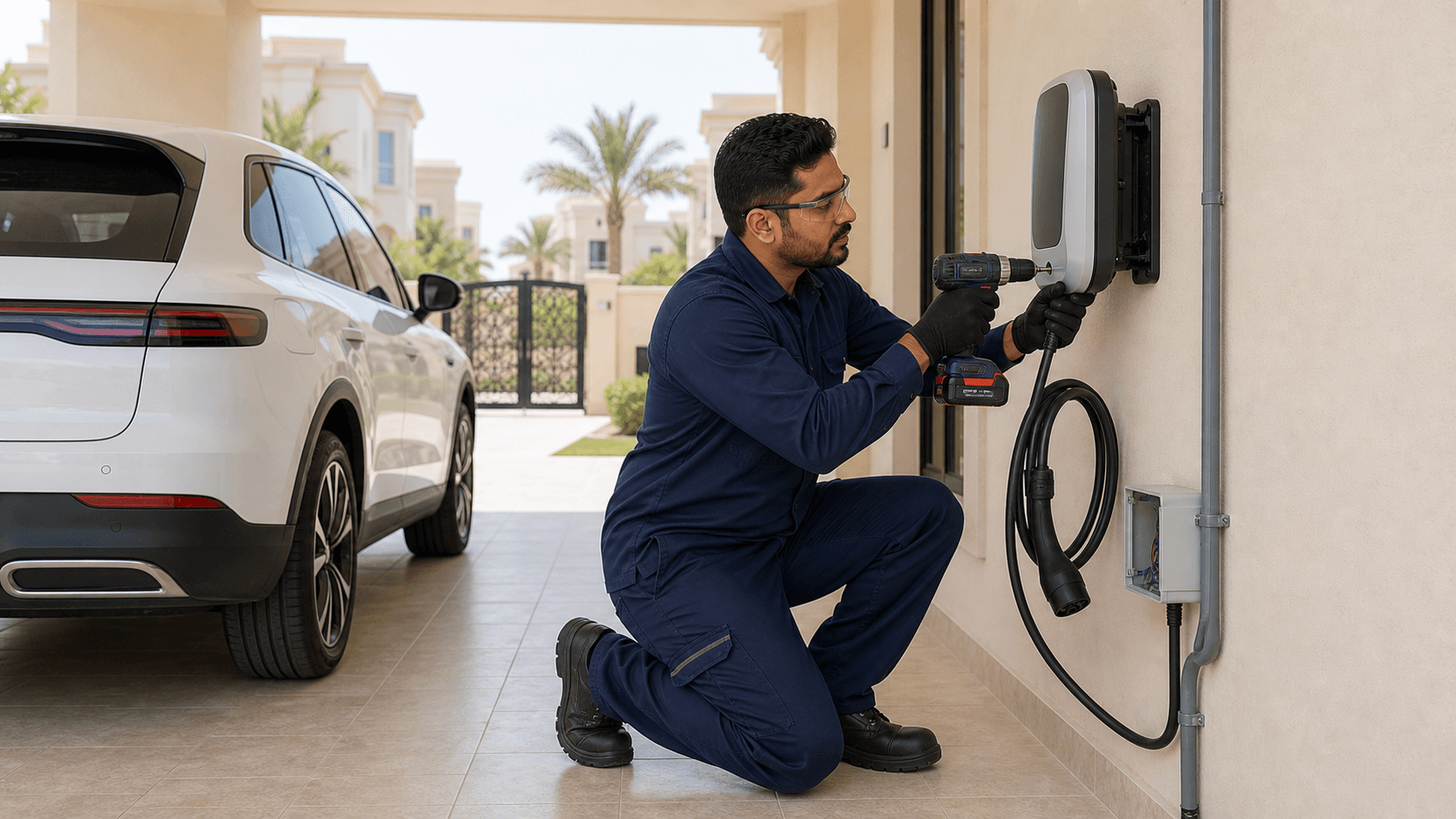
- As of June 2026, installing a 7kW or 11kW AC wallbox charger in a Dubai villa or townhouse commonly ranges from about AED 1,800-6,000+ when the cable route is straightforward.
- Apartment basement parking is usually not a simple plug-and-play job. Building management, owner association, allocated parking, metering, cable route, fire/electrical rules and DEWA-related approval checks can push the work into a custom quote.
- Before booking, compare the same charger rating, cable length, DB load check, breaker/RCD protection, earthing, approvals, testing certificate, warranty and whether the charger unit is included.
Last updated: June 2026
Bestimate is a Dubai quote-comparison platform and does not carry out the work itself.
EV charger installation in Dubai looks simple when the charger is already chosen and the parking space is next to an electrical board. In reality, the cost depends less on the wallbox brand and more on the route from power to parking: cable length, electrical load, protection devices, drilling, conduit, civil work, building approval and final testing.
This guide is written for Dubai residents comparing home EV charger quotes for a villa, townhouse or apartment parking bay. It explains realistic cost ranges, why apartments are harder than villas, what approvals to ask about, and how to compare installation quotes without accidentally comparing different scopes. For general electrical visit pricing, also see Electrician Services Dubai; for wider property maintenance planning, compare this with the Home Maintenance Contract Dubai guide and the reliable home services Dubai guide.
How much does EV charger installation cost in Dubai?
For many private-home installations in Dubai, the practical planning range is about AED 1,800-6,000+ when the job is a standard AC wallbox charger supply-and-install scope with a manageable cable route. A very simple labour-only installation may be lower if the charger is already supplied and the electrical route is short. A more complete supply-and-install quote, longer cable run, DB upgrade, outdoor conduit, trenching, extra protection devices or approval handling can move the quote higher.
| Installation scenario | Dubai planning benchmark | What changes the quote |
|---|---|---|
| Basic labour-only wallbox install | Often around AED 1,200-2,500+ | Charger already supplied, short cable route, simple wall mounting, no major DB work. |
| Standard villa or townhouse supply and install | Commonly AED 1,800-6,000+ | Charger rating, cable length, conduit, breaker/RCD protection, load check, testing and warranty. |
| Long cable route or electrical upgrade | Often AED 5,000-12,000+ custom quote | Distance from DB, trenching, wall chasing, outdoor-rated conduit, sub-board, load management or extra approvals. |
| Apartment basement parking bay | Usually custom quote | Owner association/building approval, allocated bay, cable tray route, metering, shared services, fire/electrical rules and access. |
| Commercial or shared charger | Custom, often much higher | Multiple bays, public or paid charging model, networked billing, operator approval, civil work and higher electrical capacity. |
Price benchmarks were checked in June 2026 against public Dubai EV charger installer pages, charger supply examples and official Dubai EV charging references. VAT, charger brand, approvals, civil work, electrical upgrades and utility-related requirements can change the final quote.
Villa and townhouse installations are usually the most straightforward
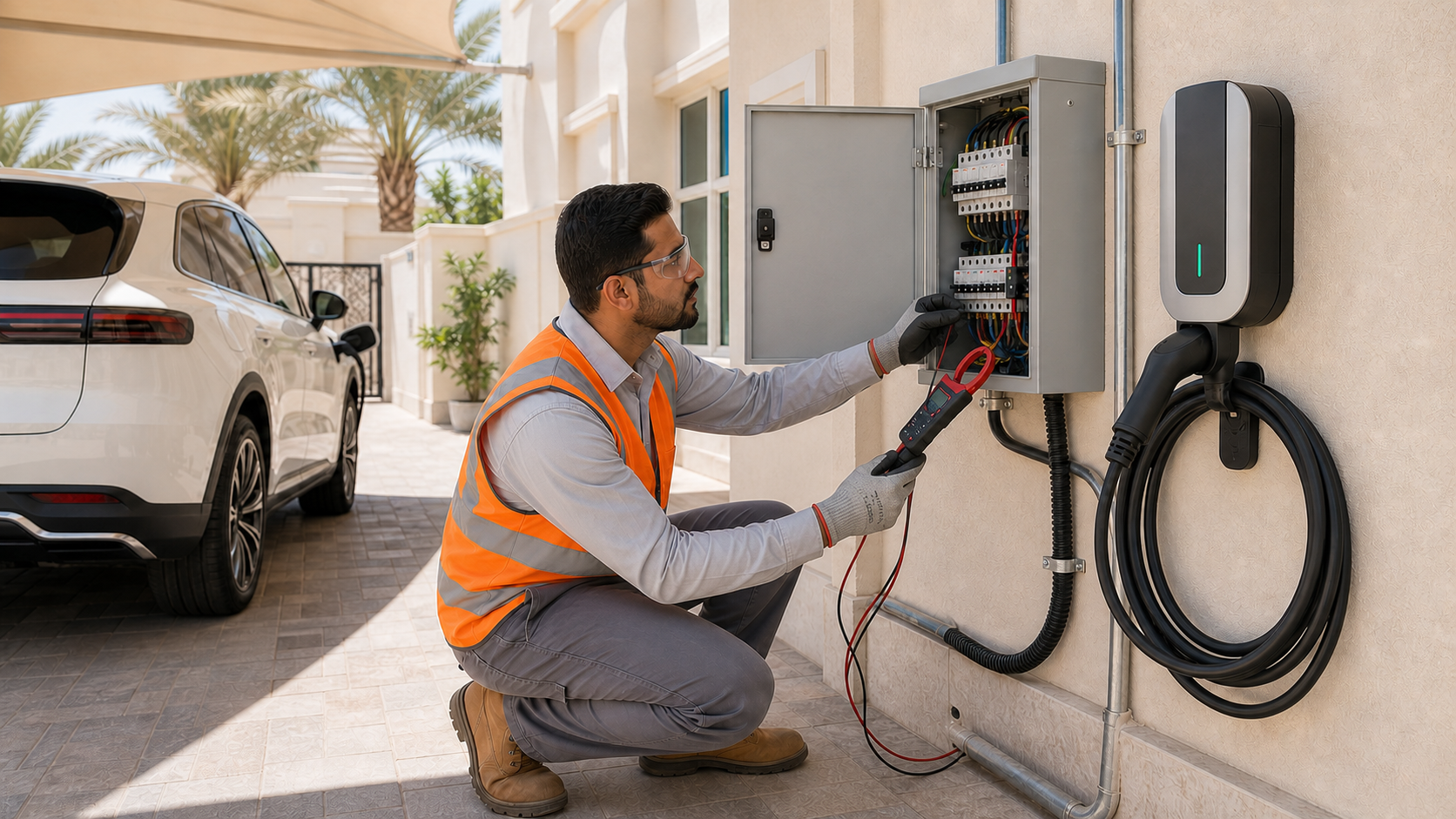
Dubai villas and townhouses are usually easier because the owner often controls the carport, wall space and electrical board access. If the main distribution board is near the parking area, the installer can assess load, run a short cable, mount the wallbox, add protection devices and test the charger without negotiating a long route through common building areas.
For a standard villa or townhouse with the DB near the parking area, a supply-and-install 7kW wallbox quote commonly falls in the AED 1,800-4,500 portion of the planning range — rising to AED 5,000-12,000+ where the cable route is long, the DB needs upgrading, or outdoor conduit and civil work are involved.
Even in a villa, do not compare prices until each provider has checked the same scope. A 7kW wallbox near the DB is different from a 22kW-capable setup, a charger on an outside boundary wall, a long cable route under tiles, or an installation that needs a new sub-board. If the charger is outdoors, ask whether the unit, enclosure, conduit and cable glands are suitable for heat, dust and occasional water exposure.
Apartment EV chargers need more approval and planning
Apartment parking bays are the part of EV charger installation that causes the most confusion. The charger may sit in your allocated bay, but the cable route often crosses common areas, shared cable trays, fire-safety zones, building electrical rooms or management-controlled parking. That means the installer may need a building NOC, owner or landlord permission, electrical capacity confirmation and a clear metering plan before work can begin.
For renters, check the landlord first. For owners, check the building or owners association. Ask whether the building already has an EV charging policy or approved contractor list. Some towers will not allow individual residents to run a private cable from the apartment meter to the basement bay. Others may require a central charging solution, separate metering, a management-approved route, or a charge point operator model for shared chargers.
| Apartment check | Why it matters | Ask before paying a deposit |
|---|---|---|
| Allocated parking bay | The charger location must match your legal/assigned bay. | Can the charger be mounted near this bay, or only in a shared charging zone? |
| Cable route | Long basement routes can dominate cost and approval complexity. | Who approves conduit, cable tray, wall penetrations and working hours? |
| Metering | The building needs a clear way to assign electricity consumption. | Will charging be billed to your meter, a sub-meter, a building account or an operator app? |
| Fire and electrical safety | Shared basements have stricter rules than private villa carports. | What protection devices, isolation, signage and testing documents are required? |
Do you need DEWA EV charger approval or building approval?
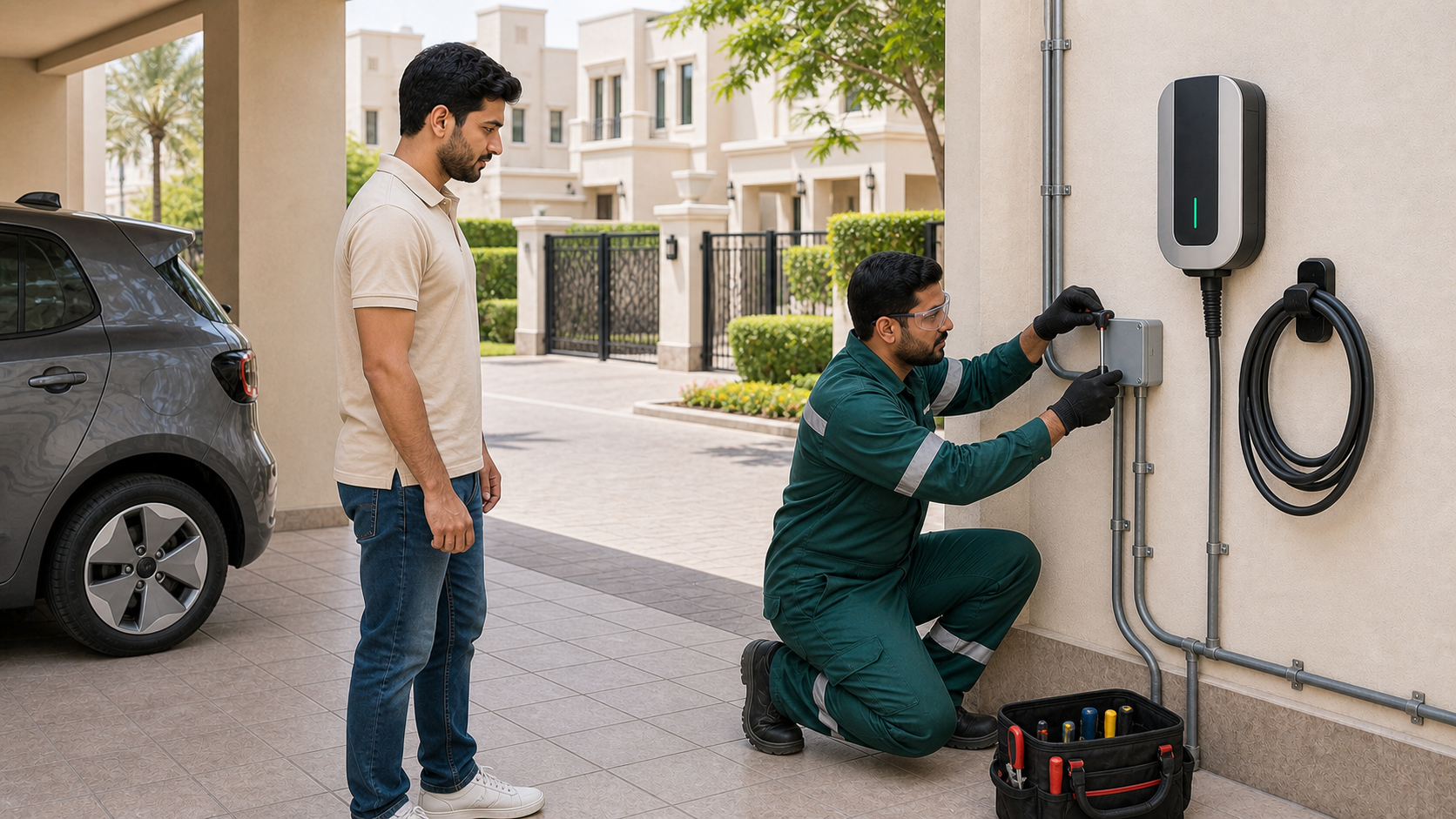
For a private home charger, treat approval as something to verify before work starts, not after the charger is on the wall. The exact path can differ by property type, community and whether the charger is private, shared or public. A villa homeowner should use a DEWA-approved or registered electrical contractor and may need utility/load checks. An apartment resident may also need landlord, building management or owners association approval. A public or paid charging station is a different category and can involve charge point operator requirements.
Dubai's official EV charging ecosystem uses DEWA and Dubai EV charging frameworks, and public charging tariffs are separate from the cost of installing a private wallbox. Do not assume that a private home charger can be installed with an extension lead, an ordinary socket or a casual handyman visit. Ask for a written installation method, protection devices, testing and handover documents.
7kW, 11kW or 22kW: which charger should you quote?
Most home charging conversations in Dubai start with AC wallbox chargers. The right size depends on the vehicle's onboard charger, the available electrical supply, whether single-phase or three-phase power is available, and how quickly you need to charge overnight. A higher-rated charger is not automatically better if the car, home supply or building rules cannot support it.
| Charger choice | Typical use case | Quote check |
|---|---|---|
| 7kW AC wallbox | Common private home charging where overnight charging is enough. | Confirm circuit protection, cable size, earthing and whether the car supports the expected rate. |
| 11kW AC wallbox | Useful where three-phase supply and vehicle support make it practical. | Ask the installer to verify available phases and load capacity before quoting. |
| 22kW AC wallbox | Can be suitable for some villas or shared/private setups, but not every car or supply can use it fully. | Do not pay more unless the car, wiring, breaker, cable route and building supply make it useful. |
| DC fast charger | Usually commercial, fleet or public charging, not a normal home wallbox. | Expect custom engineering, operator, utility and site-power discussions. |
What should be included in a proper quote?
A good EV charger quote should make the installation method clear enough that another provider can quote the same job. If one quote includes charger supply, protection devices, cable, conduit, testing, certification and warranty while another only includes labour, the two prices are not comparable.
- Charger brand/model, output rating and whether the charger unit is included.
- Cable length, cable size, conduit or cable tray route and any drilling or trenching.
- DB load assessment, breaker, RCD/RCBO, isolation switch and surge protection if required.
- Earthing check, testing, commissioning and user handover.
- Building, landlord, community or utility approval support if applicable.
- Warranty for charger hardware, workmanship and revisit terms.
- Whether VAT, site visit, drawings, civil work and extra cable are included or separate.
- Confirm whether the quoted price includes 5% UAE VAT; if VAT is charged, ask for a UAE tax invoice with a TRN.
Common red flags
Be careful with any quote that treats EV charger installation as the same as adding a normal socket. EV charging is a sustained electrical load, so shortcuts can create overheating, nuisance tripping, warranty problems or building approval issues.
- ✓Load check before final price
- ✓Written cable route and protection details
- ✓Clear approval and testing notes
- ✓Hardware and workmanship warranty
- !No DB inspection or load calculation
- !Ordinary socket or extension lead suggestion
- !Apartment approval ignored
- !No testing, warranty or handover document
What to send before requesting quotes
- Car model and maximum AC charging rate if you know it.
- Villa, townhouse or apartment, plus whether you own or rent.
- Photos of parking bay, wall location, existing sockets, DB panel and cable route.
- Approximate distance from the electrical board to the charger location.
- Whether the charger is already purchased or should be supplied by the installer.
- Any building, landlord, owner association or community approval already requested.
- Whether you need a smart charger, app control, load management or usage reporting.
Home charging versus public charging in Dubai
Home charging is about convenience and predictability. Public charging is about access when you are away from home. Dubai's public EV charging network and tariffs are useful context, but they are not the same as the installation cost for a private wallbox. A home charger normally uses your property's electricity arrangement, while public charging stations follow their own tariff and operator model. Electricity used by a private home charger is normally added to your regular DEWA bill at standard residential rates, separate from the tariffs charged at public charging stations.
If you drive daily, a home wallbox can reduce the stress of finding a public charger, especially if you live in a villa or townhouse. If you live in an apartment where approval is not available, it may be more practical to rely on building-provided shared chargers, nearby public chargers or a managed charging operator until the building creates a formal EV charging policy.
Updated June 2026. Bestimate reviewed Dubai EV charger installation pricing, public EV charging context, apartment approval issues and electrical safety scope, including DEWA EV smart charging information, Dubai EV Hub, MOEI EV charging station open data, and RTA EV charging station information.
Price ranges are planning benchmarks, not fixed quotes. Final pricing still depends on property access, cable route, electrical load, charger model, materials, approvals, VAT and provider availability.
Ready to compare local quotes?
Tell us your parking setup, charger type and cable route. Bestimate helps you compare EV charger installation Pros in Dubai by price, scope, timing and terms.
Compare EV charger installation quotes now
Free requestNo obligationLocal Pros
Bestimate reviews UAE home-service guides for local pricing context, service-scope clarity, safety considerations and practical quote-comparison accuracy.
EV charger installation pricing was checked in June 2026 against public Dubai installer benchmarks, charger supply examples and official Dubai EV charging references. Ranges are planning benchmarks, not guaranteed quotes.
Local Dubai context: In Dubai, a home EV wallbox should be installed by a DEWA-registered electrical contractor, and apartment or gated-community installs (for example in towers in Business Bay or villas in Arabian Ranches) usually also need owners-association or developer NOC approval for the cable route and parking bay before work starts.
Frequently asked questions
How much does EV charger installation cost in Dubai?
As of June 2026, many Dubai home EV charger installation quotes fall around AED 1,800-6,000+ for a standard villa or townhouse wallbox job. Long cable routes, charger supply, DB upgrades, outdoor conduit, apartment approval and civil work can push the quote higher.
Can I install an EV charger in a Dubai apartment parking bay?
Sometimes, but it depends on building management, owner association rules, allocated parking, cable route, metering and electrical capacity. Ask the building for its EV charging policy before paying a provider deposit.
Do I need DEWA approval for a home EV charger?
For a private villa, use a DEWA-approved or registered electrical contractor; a dedicated circuit, load check and correct protection devices are typically required before energising the charger. Apartment residents also need building management or owners association approval before work begins. The exact path varies by property type, charger model and whether the charger is private, shared or public — ask the installer to explain the required approval steps in writing.
Is a 22kW charger worth it at home?
Only if your car, electrical supply and installation route can actually use it. Many residents are better comparing a properly installed 7kW or 11kW wallbox before paying more for a higher-rated charger that the car or property cannot fully support.
What should an EV charger quote include?
It should include charger model and rating, cable length and route, DB load check, breaker/RCD protection, earthing, conduit, approvals, testing, warranty and whether the charger unit is supplied or labour-only.
Is home EV charging billed separately from my DEWA bill?
Usually no. For a private home charger, electricity consumption is normally added to the regular DEWA bill for the property at standard residential rates. That is separate from public EV charging tariffs and operator models.
Can I charge an EV from a normal socket or extension lead?
Do not treat a normal socket or extension lead as a proper home charging solution. EV charging is a sustained electrical load, so use a DEWA-approved or registered electrical contractor, dedicated circuit protection and correct testing.