Quick answer
If your AC still smells after cleaning, do not automatically book another duct clean. Ask the original provider what was cleaned, record when and where the smell occurs, and request an inspection of the relevant unit and drainage arrangement. A smell description alone cannot identify mould, a refrigerant leak, an electrical fault or the right repair.
Stop conditions come before troubleshooting
If there is a burning smell, smoke, sparking or unusual heat, stop using the AC. Isolate its supply only from a dry, safely accessible control you can identify; otherwise keep clear and seek help. Do not restart it to reproduce the smell. Daikin's troubleshooting guidance directs users with a burnt odour to stop operation, disconnect the supply and contact service. For smoke or fire, leave the affected area and contact emergency services.
For a strong unexplained gas-like or chemical odour, move away and contact building management or the appropriate emergency service; do not use this guide to rule out a hazard. If anyone has significant symptoms, seek medical help. An AC cleaning appointment is not a medical or indoor-air safety assessment.
Use this observation-to-service table, not a remote diagnosis
| Observation | Useful information to record | Appropriate next step |
|---|---|---|
| New smell immediately after cleaning | Cleaning date, affected units, products reported used and any changed settings. | Contact the original provider for its product instructions and post-service review. Do not assume every new odour is harmless residue. |
| Old smell returns when one AC starts | Which unit/room, startup or continuous occurrence, and whether it was present before cleaning. | Request unit-specific inspection and compare the actual cleaning scope with the findings. |
| Smell strongest near a bathroom, drain or ceiling opening | Where it is strongest from normal room use, and whether it also occurs with the AC off. | Ask the AC technician to assess whether another source or drainage connection needs building management/plumbing involvement. |
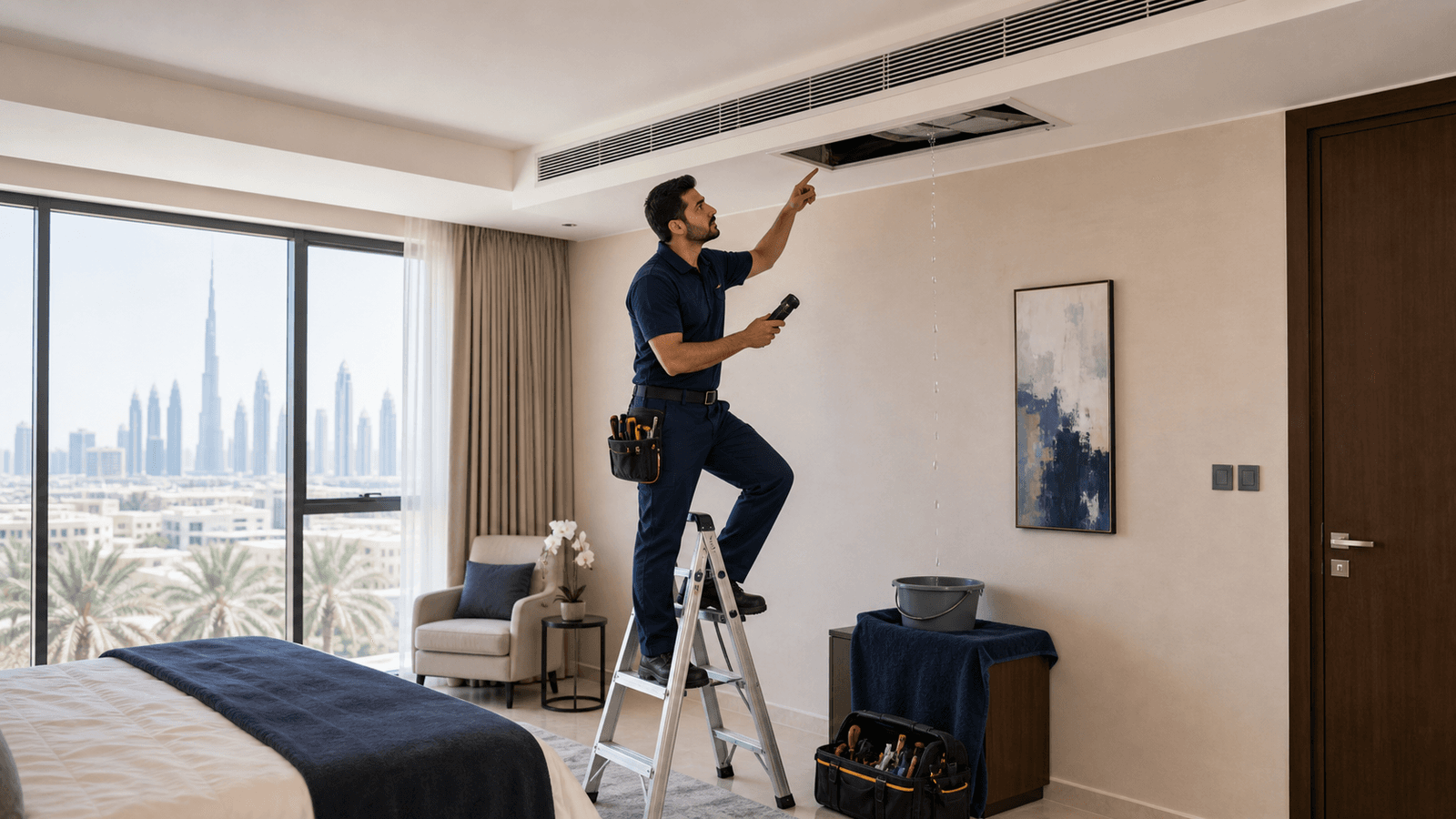
| Smell with dripping, damp staining or poor cooling | Safe photographs and timing of the accompanying symptom. | Report both symptoms for an AC assessment; do not purchase fragrance treatment as the repair. |
| Similar smell in several rooms or shared areas | Which rooms are affected and any known shared-system or building work. | Inform building management as well as the technician; establish the private-unit versus common-system boundary. |
These observations help direct the visit but do not prove cause. You do not need to climb up, remove a grille, open an access panel or intentionally run a suspect unit to complete the list. Record what you have already noticed from a safe position.
Why ‘AC cleaned’ may not describe the whole job
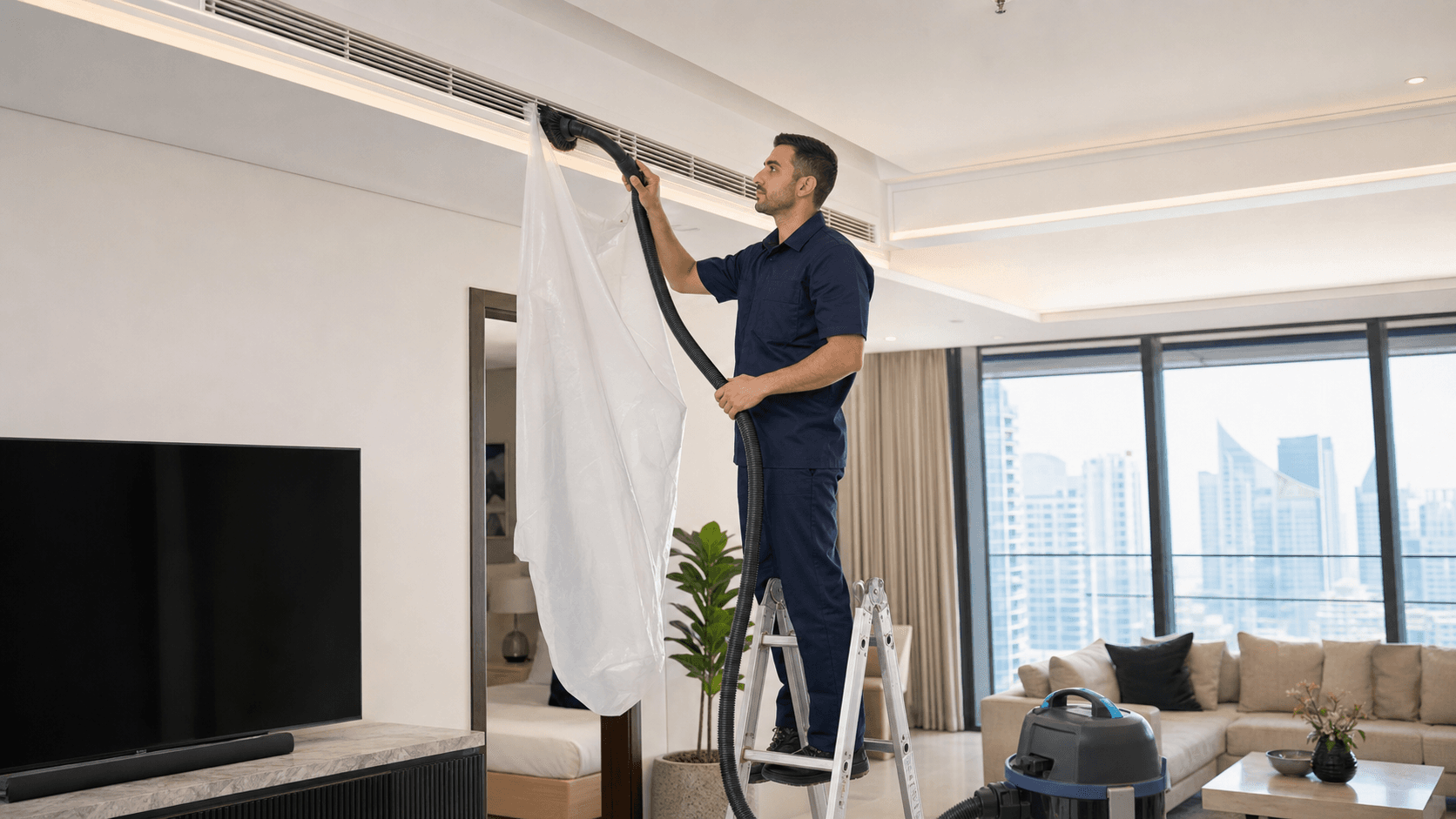
Cleaning a removable filter, washing a coil, removing a blower, clearing a condensate path and cleaning ducts are separate operations. The Fab Crew's Dubai service descriptions list different component scopes for maintenance and deeper cleaning, and note that access affects the work. This is a useful reason to ask for the visit record—not proof that the cheapest or most expensive package is right.
| Component or work item | Question for the previous provider | Evidence to ask for |
|---|---|---|
| Filters and visible grilles | Were these the only items cleaned, or part of a larger service? | Unit-by-unit checklist; note any filters requiring a specified replacement. |
| Coil, blower and drain tray | Which components were accessed and treated, and which could not be reached? | Relevant before/after views and a record of inaccessible areas—not unrelated stock photos. |
| Condensate route | Was drainage function checked and were defects found? | Recorded findings and any separate repair recommendation. |
| Ducts and insulation | Was there evidence justifying duct work, and what sections were actually included? | Identified locations, material condition, access limits and the proposed scope. |
| Products and handover | What product was used, where, and what instructions apply afterwards? | Product identification, applicable safety information and written handover advice. |
For package pricing, see the Dubai AC cleaning scope and cost guide. Here, the next decision is a targeted inspection or callback.
An odour can be carried by the AC without originating in the ducts
Mitsubishi Electric's FAQ identifies room odours and contamination around the cooling coil or drain pan as possible explanations for unpleasant air from an indoor unit. That is not a way to diagnose your system by calling a smell ‘sour’ or ‘musty’. Ask what the inspection found and how the proposed work addresses it.
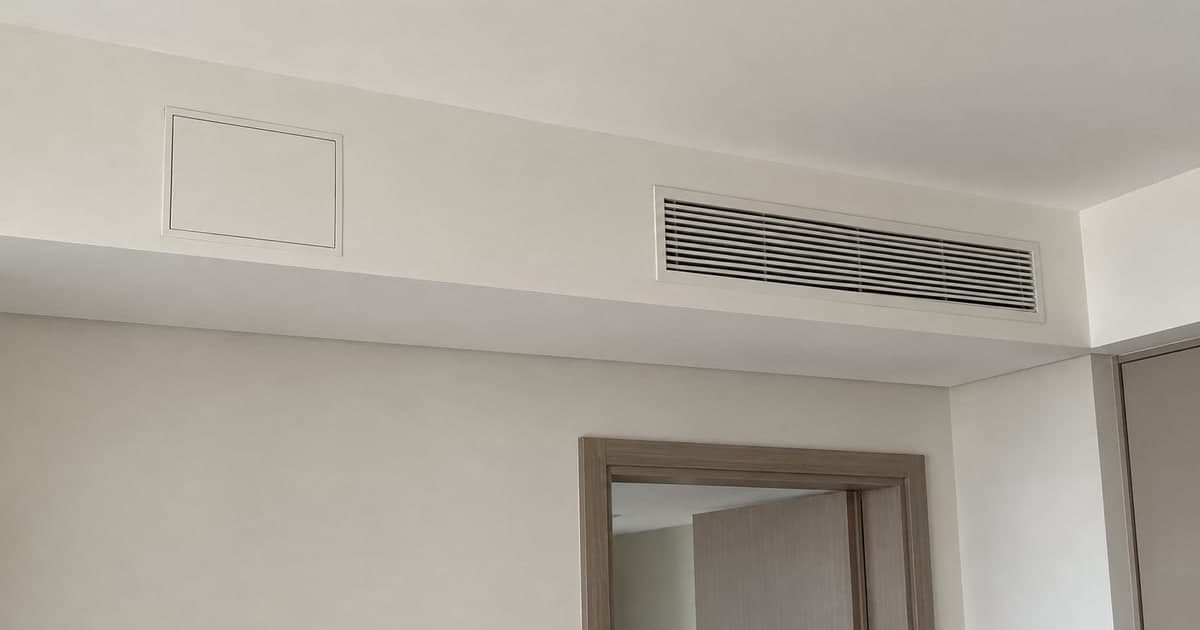
In Dubai apartments with concealed fan-coil units, the accessible grille and the service access opening may be different. Confirm who will provide access and make good any authorised opening. In a villa, identify the particular zone and unit rather than ordering the same work for every room. Keep system type, number of units and access limits in the quotation.
Some visits genuinely need more than one trade. The Fab Crew's odour-inspection description includes consideration of drain or outlet odours affecting the air system. Request plumbing only when the assessment identifies that route; proximity to a bathroom alone does not prove a plumbing fault. Building management may need to investigate common infrastructure.
When duct cleaning is—and is not—the next purchase
The US EPA's duct-cleaning guidance does not support a blanket cleaning recommendation for every home. It advises considering evidence of contamination and underlying causes, and cautions against broad health-benefit promises. Ask the provider to show the relevant findings, explain the duct material and identify what will be cleaned or replaced. This is technical consumer guidance, not a Dubai approval or licence.
A quotation labelled ‘deep cleaning’ should name the proposed work and its unit-specific rationale. Do not automatically buy—or rule out—duct work before that assessment.
Use the AC duct-cleaning quote guide when that scope has been justified. If water leakage is also present, see the AC water-leak guide and tell the provider about both issues.
Avoid masking the problem or adding incompatible chemicals
Do not spray perfume, bleach, household disinfectant or an arbitrary cleaner inside the unit. Daikin warns against ordinary commercial cleaning agents inside its AC units because incompatible products can damage components. Ask for the actual product's approved application and equipment compatibility; do not mix chemicals or improvise a flush.
If a provider proposes fogging, a biocide, a coating or ozone treatment, ask why that specific intervention is needed, what manufacturer and product instructions permit, what occupancy precautions apply, and what physical fault it addresses. Do not accept a fragrance, an unexplained ‘sanitisation’ label or a smell-free handover as proof that hidden conditions or health concerns have been resolved.
Request an inspection or recall with a clear cost boundary
There is no defensible single ‘AC smell repair price’ before the scope is known. Start with the original provider's written callback terms. If you need another provider, confirm the assessment fee, number of units, access, written findings, VAT and whether any fee is credited against approved work. A paid inspection and a free quote request are different things.
- Ask for the observed finding, not only a package name. What was checked, what was inaccessible and what remains uncertain?
- Separate further cleaning, drainage repair, component replacement and ceiling access/making good. Ask for approval before chargeable additions.
- Define the follow-up: who to contact if the original symptom persists, what is included and what counts as a newly identified fault. Do not assume a guaranteed cure or free return.
Copy this brief for the next provider
- The AC was cleaned on [date]. The smell [started/continued/returned] afterwards, affecting [rooms/units]. It occurs [at startup/continuously/at another observed time].
- The previous invoice says [named scope]. Known access limitations or recommended but unfinished work: [details].
- Other observed symptoms: [none, dripping, stain, noise, reduced cooling, error code]. Do not restart a unit with a safety concern to collect more information.
- Please assess the source, report findings and quote only the justified next work, with inspection fee, parts, access, VAT and callback terms separated.
Share invoices and system details privately. Crop or blur names, addresses, phone numbers, unit numbers, delivery labels, barcodes, serial labels and unrelated faces from any photographs. Put contact and access instructions in private booking fields, not in the picture.
Use Dubai AC repair and inspection services when the cause remains unresolved, and ask what the assessment covers before agreeing to further cleaning.
Compare targeted AC inspection quotes
Describe the smell timing, affected units and the previous cleaning scope. Compare multiple quotes for free, then confirm any inspection fee and proposed work directly with the provider.
Compare Quotes for FreeFrequently asked questions
Why does my AC still smell after it was cleaned?
The recorded cleaning scope may not address the source, or the odour may come from another part of the unit or surrounding system. Ask for a review of the findings and work completed. A smell description cannot establish the cause remotely.
Is a chemical smell normal after AC cleaning?
Do not assume it is harmless or that every product has the same ventilation or re-entry instructions. Contact the provider for the product used and its specific guidance. Move away from a strong unexplained odour and seek appropriate help if there are safety concerns or symptoms.
Does a musty smell prove that the ducts contain mould?
No. Odour alone does not identify a substance or its location. Request an appropriate inspection and evidence supporting any contamination claim, rather than paying for a predetermined treatment.
Should I call a plumber or an AC technician?
For an unresolved smell associated with AC operation, an AC inspection is usually the starting brief. If the assessment points to drainage or another building source, involve the relevant plumbing or management team. Do not select a trade solely from the smell's description.
Will another duct clean definitely remove the smell?
No guarantee follows from the package name. The next scope should address the assessed problem and specify components, access and follow-up. A whole-home duct clean is not automatically the right response to one room's symptom.
Should the original cleaning company return for free?
Check the written callback terms and report the timing and symptoms. Ask whether the return is included, charged as an inspection or treated as new work. Do not assume a free visit or guaranteed remedy.
Sources and review method
Reviewed 16 September 2026 by Bestimate Editorial Team. Manufacturer troubleshooting informs safety boundaries. A Dubai provider's descriptions show scope distinctions, not verified quality or outcomes. EPA guidance informs duct-service purchasing, not UAE regulation. No smell-to-diagnosis formula, guaranteed cure, health claim or invented repair price is used.