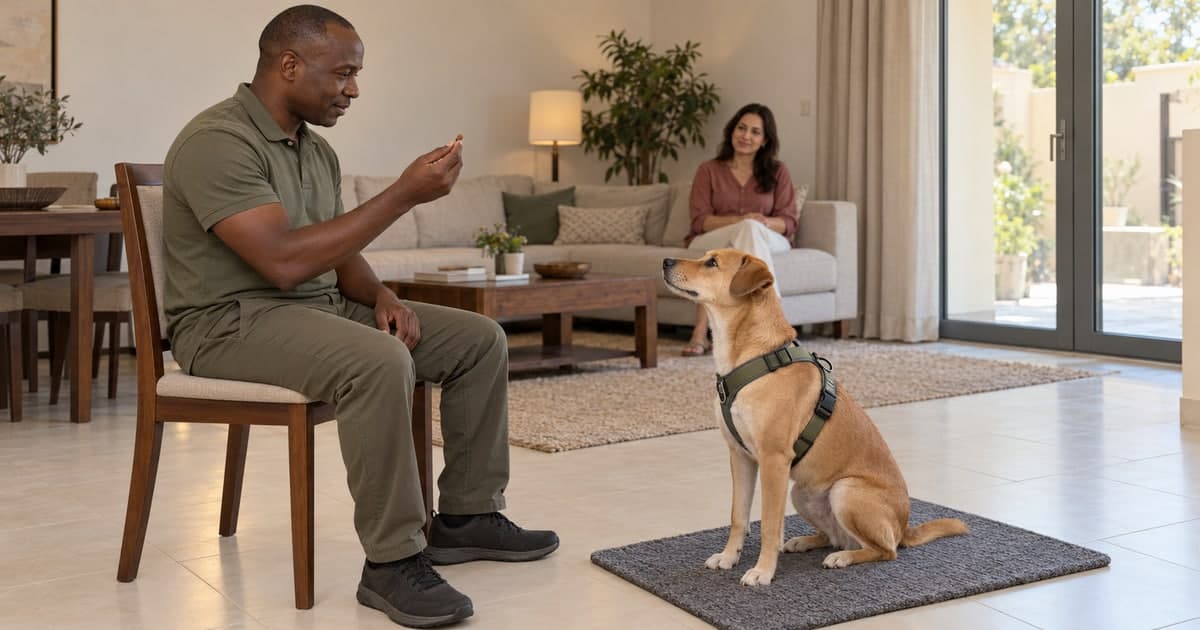
In-home dog training in Dubai means a trainer visits your home and teaches both your dog and the people who care for it. Compare the initial assessment, training methods, owner participation, session length and written goals before comparing package prices. A cheap cost per session is not useful if nobody explains what you should practise safely between visits.
Current provider examples include a five-session puppy/young-dog package advertised at AED1,990 and a twelve-session home package at AED4,000. Those are different programmes, not a recommended number of sessions or a Dubai-wide price range. This guide explains what the figures do—and do not—tell you.
When a home visit is the relevant service
In-home dog training is a practical format when the goal involves everyday routines in the place your dog lives: settling while you work, responding to familiar cues, or helping a new puppy learn household expectations. The trainer can discuss the environment and coach the people who will continue the work.
It is different from dog walking, pet sitting or boarding with training. Walking provides the agreed outing; sitting provides agreed care; residential training takes place away from your home. Do not compare their daily or hourly charges as though they buy the same service.
Ask first whether your concern belongs with a veterinarian or qualified behaviour professional. A sudden behaviour change, new fear or aggression should not be treated as simple disobedience. Dogs Trust's guidance recommends veterinary advice for concerning changes, which can have underlying causes.
Open the full quote comparison calculator. This tool uses your written quotes, not a market-price estimate. Enter two written quotes for the same scope. Unknown costs stay incomplete; confirm VAT, exclusions and booking terms before comparing.
What do published Dubai home-training packages cost?
The following examples were checked on 20 October 2026. They show how to read a package, not which provider to select. Little Tails specifies 60-minute sessions; the reviewed Doggy Doggy Home offer does not state session minutes. VAT was not explicit beside either offer, so a direct all-inclusive hourly comparison would be misleading.
Named home-training offers and their comparison limits
| Provider and advertised scope | Published package | Arithmetic only | Ask before comparing |
|---|---|---|---|
| Little Tails Training: five-session obedience and potty package for puppies/young dogs, per dog | AED1,990 / 5 sessions of 60 minutes | AED398 per included session | Suitability, travel, assessment scope and written terms. A conditional extra session is not counted. |
| Doggy Doggy Home: home/in-house visits with owner guidance | AED4,000 / 12 sessions, advertised twice weekly | About AED333.33 per included session | Minutes, home-visit area, schedule flexibility and package expiry. Do not confuse it with the separate residential programme. |
A lower calculated session price does not establish better value: the packages differ in target dogs, number of visits and stated scope. Neither division predicts how quickly a particular dog will learn. Ask for a quote based on assessment and achievable goals, with any assessment fee, travel, equipment, tax and follow-up support stated separately.
What should happen at the first visit?
Before the trainer arrives, explain your dog's age, household routine, previous training and the situations that concern you. Disclose any bite history or safety concern privately so the professional can plan an appropriate arrival. Do not arrange a stressful demonstration or bring visitors close to provoke a reaction.
A useful first appointment sets priorities, discusses what success would look like and explains how the household will participate. Ask for a manageable written plan and clarity about what the trainer will observe, what you should practise and what should be left alone pending further assessment. A promise to fix every problem in a single visit is not a substitute for that process.
Agree who needs to attend. If several adults or a regular caregiver handle the dog, the plan should explain their roles and use consistent instructions. Children should not be assigned responsibility for managing a difficult or unsafe interaction.

Choose reward-based training, not a guaranteed “quick fix”
The American Veterinary Society of Animal Behavior's humane training position recommends reward-based methods and rejects training that relies on force, pain or fear. Its guidance applies to teaching skills as well as addressing unwanted behaviour; serious concerns may require a wider professional treatment plan.
Ask a prospective trainer what happens when the dog makes a mistake, becomes worried or does not respond. Ask what equipment they use and whether you can observe the whole process. Avoid approaches involving shock, painful corrections, intimidation or attempts to force the dog through a frightening situation. “Balanced” or “results guaranteed” is not a sufficiently specific explanation of methods.
Request evidence of relevant education and experience with your actual goal. A social-media clip, business name or claim of being an animal lover does not by itself establish training competence. No package should promise an identical outcome for every dog.
A useful package comparison checks more than session count
Questions that make two training quotes comparable
| Compare | What you need in writing |
|---|---|
| Assessment and goals | What the first visit covers, whether it counts as a session and how goals will be reviewed. |
| Time and place | Minutes per visit, your home address/area, any proposed outdoor work and whether travel is included. |
| Owner involvement | Who attends, written practice guidance and how questions between visits are handled. |
| Methods and limits | Reward-based methods, equipment, safety planning and when veterinary/behaviour referral is needed. |
| Payment and unused visits | Final payable total, expiry, cancellation, refunds, trainer substitution and missed-visit rules. |
For budget comparison, divide confirmed package charges by the included visits, then consider how many you can actually attend before expiry. Calculate an hourly figure only when the live session minutes are known and the scopes genuinely match. Do not count a conditional bonus session as guaranteed, or assume unknown travel and tax charges are zero.
Prepare your home and track progress without pressure
Provide access instructions and tell the trainer about stairs, shared entrances, other pets and children. Agree on a calm arrival plan and the equipment they want available. For any outdoor element, discuss a suitable location and conditions; a Dubai home booking should not depend on an unplanned session in an unsuitable shared area.
Keep a brief record of the agreed goal, context and what the trainer asks you to observe. Record progress honestly rather than testing the dog repeatedly in difficult situations. Ask for the plan to be reviewed if the dog seems distressed, the household cannot follow it or the goal changes. Progress is more useful than a marketing promise of perfect behaviour by a fixed date.
Compare In-Home Dog Training Quotes. Confirm the written scope, price and availability before booking.
Frequently asked questions
How many home-training sessions will my dog need?
There is no reliable universal number. The goal, dog's history, household participation and professional assessment matter. Use package counts to understand what you are buying, not as a prediction of results.
Do I need to be present?
For owner-coaching goals, plan to participate and confirm who else should attend. A trainer-only visit may be a different service, and it does not automatically teach the household how to continue the work.
Can a trainer visit for aggression or biting?
Disclose the concern before booking and seek appropriate veterinary or qualified behaviour support. Do not arrange a normal obedience visit without telling the professional, and do not try to demonstrate the behaviour unsafely.
What should I send to request comparable quotes?
Provide your area, dog's age, the main goal, household availability and any safety concerns privately. Ask for the assessment process, methods, session minutes, owner role and full home-visit package terms through the in-home dog-training category.
Sources and review scope
Reviewed 20 October 2026. Provider offers are illustrative, not endorsements or Bestimate tariffs. Training advice here is about choosing a service; it is not a diagnosis or an individual behaviour-treatment plan.