Quick answer
A breaker that keeps tripping needs its cause investigated, not repeated resets or an automatically larger replacement. Stop using affected equipment if there is smoke, sparking, scorching, heat, a shock or water near electrics. For a non-emergency internal fault, compare the diagnostic visit first: reviewed Dubai provider references include AED 150–300 assessment bands and fault-finding services advertised from AED 349. Neither is a guaranteed complete repair price.
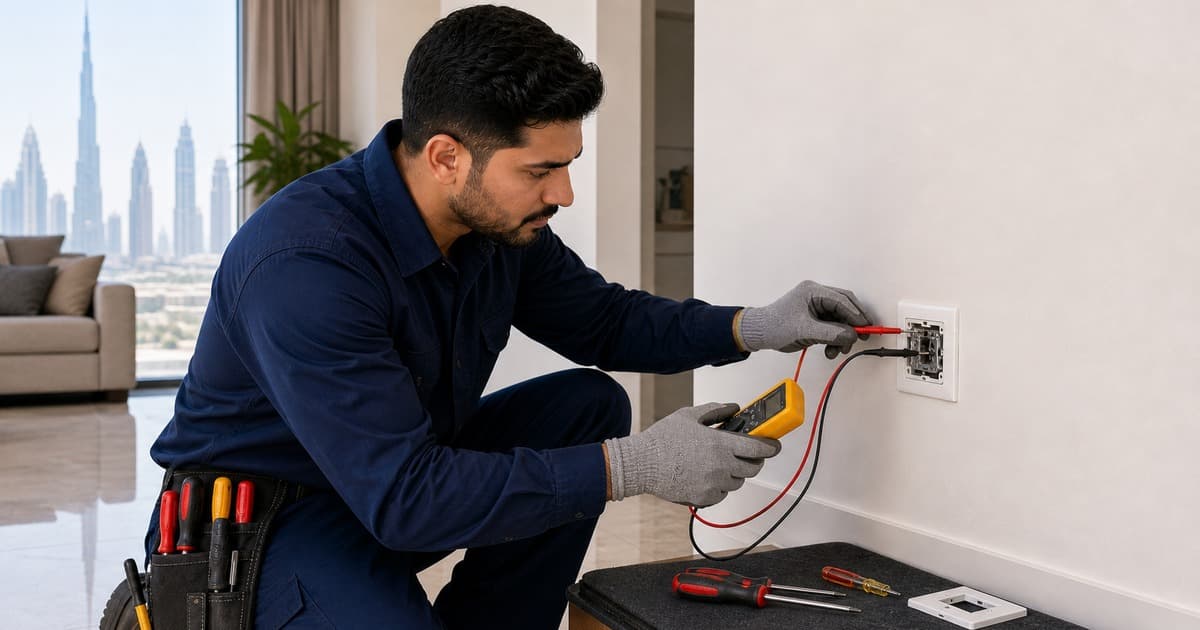
This guide is for recurring trips inside a Dubai apartment or villa: what to record safely, who should investigate, and how to compare power-trip repair quotes. It does not identify the fault remotely. If you need a new socket, lighting installation or an unrelated electrical job, use the broader Dubai electrician cost guide.
First: stop the hazard, not the protective device
Do not keep resetting a breaker to see whether it will stay on. Southern California Edison’s utility guidance says repeated trips should not be reset until the cause is corrected. Do not hold or tape a breaker on, bypass protection, open the distribution-board cover or ask someone to increase the breaker rating simply to avoid trips.
- Smoke, active sparking, a burning smell, scorching, a shock or obvious heat damage: move away and seek urgent professional help. For fire, immediate danger or injury, use emergency services; price comparison can wait.
- Water near sockets, a distribution board or electrical equipment: keep clear. Do not enter standing water or approach a wet panel to switch it. Tell building management and the electrician about both the electrical symptom and the water source.
- Repeated trips without visible danger: stop using the affected circuit/equipment and arrange competent fault finding. Do not reproduce the event by plugging things in again or repeatedly starting a suspect appliance.
- A power cut affecting neighbours or shared areas: ask building management about the wider interruption. Do not enter a locked electrical room, open meter equipment or assume that every outage is a private breaker problem.
For Dubai electricity-supply incidents, DEWA Smart Response or 991 is the appropriate utility route. DEWA distinguishes supply-side issues from internal faults, which may be referred to a private maintenance provider. Visits and customer-side issues can attract charges; do not assume a free internal repair. Building maintenance should coordinate access to common equipment.
What your observations can—and cannot—tell the electrician
Record what already happened. You do not need to provoke another trip, remove a cover or perform electrical measurements. Timing helps narrow the investigation; it does not establish the cause by itself.
| Already observed | Useful detail to record | Scope to ask about—not a diagnosis |
|---|---|---|
| Trip while several appliances were running | Which appliances and rooms were in use at the time | Circuit/load assessment and fault finding; not an automatic breaker upgrade. |
| Trip when a particular appliance started or during its cycle | Appliance type, start-up versus later operation, any recent repair | Distinguish the appliance from its supply circuit before choosing electrical or appliance repair. |
| Trip after a leak, rain or outdoor work | Location and timing of water or recent works, observed from a safe place | Electrical isolation/assessment plus correction of the water source where needed. |
| Intermittent trips with no clear pattern | Dates, duration, affected rooms and whether the same area lost power | Agreed diagnostic allowance and a plan if the fault does not appear during the visit. |
| Most or all of the home loses power | Whether neighbours/common areas are affected; information from building management | Check the supply route and extent of the interruption before booking a private repair. |
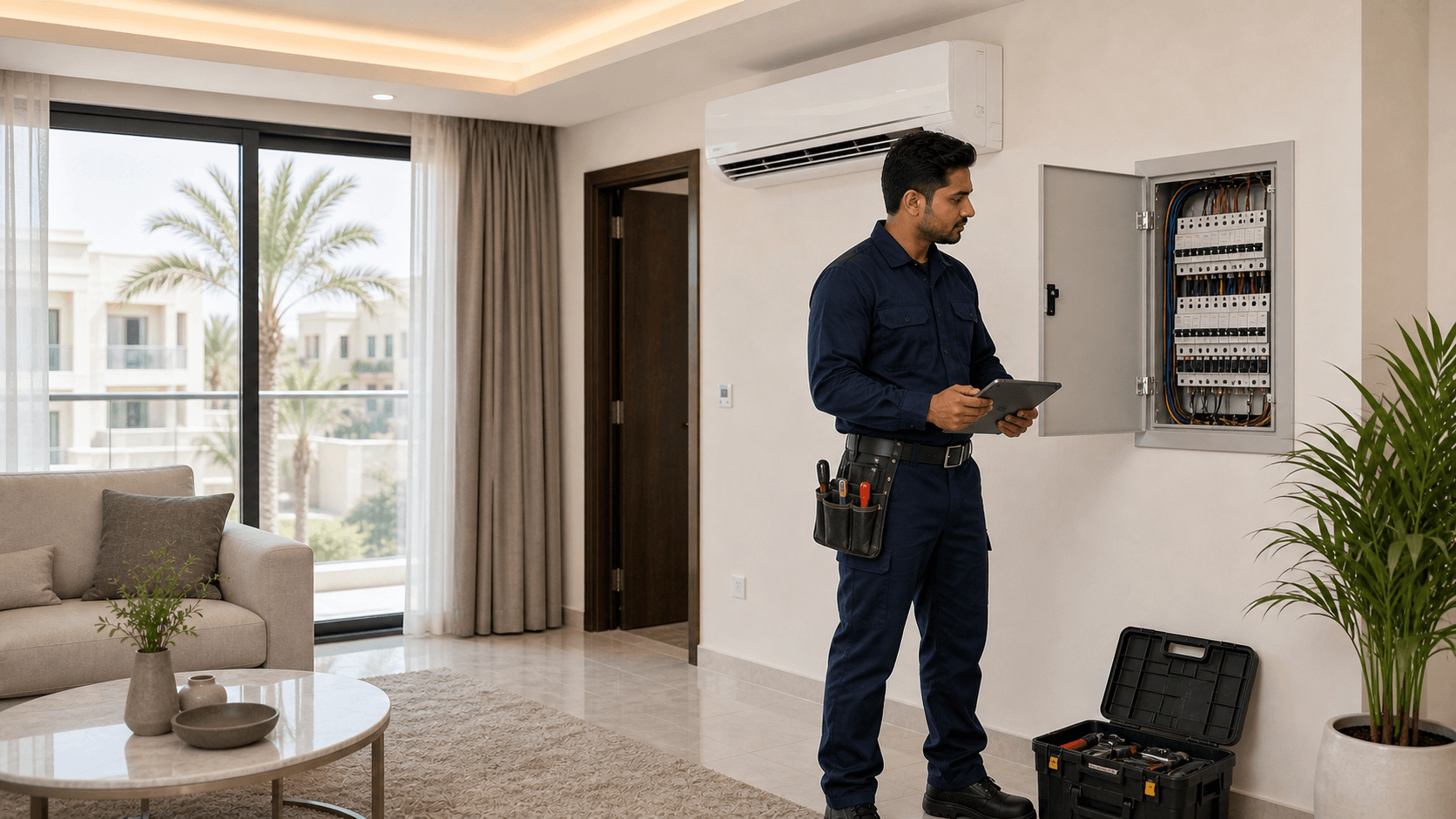
As Schneider Electric’s breaker guidance explains, thermal-magnetic trips can involve load or circuit conditions, not only a defective breaker. Different protective devices also do different jobs. An MCB addresses overcurrent; an RCCB detects residual-current imbalance but does not itself provide overcurrent protection; an RCBO combines the functions. The DEWA electrical-installation regulations distinguish these devices. A resident’s description of “the main switch” is not enough to specify a replacement.
Dubai diagnosis and repair prices: keep the units separate
These are indicative AED planning references from public provider pages checked on 16 September 2026, not quotes or Bestimate transaction averages. They do not describe an identical job. The amount of testing, included time, parts, timing, access and repair scope must be confirmed in writing.
| Published reference | Advertised amount and unit | How to read it |
|---|---|---|
| SKN: call-out and safety assessment | AED 150–300 per assessment/call-out, directional band | Its 2026 guide explicitly says this is not a fixed tariff. Confirm included diagnostic time and VAT. |
| Downtown Services: fault finding and repair | From AED 349 per call-out | Starting price for a defined service, not every fault or replacement. Confirm final testing and repair scope. |
| Fixit UAE: standard MCB replacement | AED 200–450 for the stated replacement job | Its still-public October 2025 guide includes call-out, part and labour; final fixed quotes are described as including applicable tax. Reconfirm current pricing. |
| SKN: minor component work | AED 150–500 directional band for an existing MCB/socket/switch/light-point job | This groups different jobs. It is not the price to resolve every recurring trip or replace a complete board. |
A correct repair might involve an appliance, damaged wiring, a connection, moisture or protection equipment. Major rewiring, board replacement, new loads and shared-supply work need an assessed scope. Do not add a diagnostic visit to an all-in repair quote if it is already included, and do not treat an advertised reset charge as proof the fault is repaired.
Compare the cost of investigation and the approved repair
Enter two written quotations below. The calculator separates what you owe if you stop after the entered investigation from the total if you accept the proposed repair. Add extra approved diagnostic hours only beyond the initial allowance; mark package-covered parts and testing as included. A confirmed visit-fee credit is deducted only when the repair proceeds.
Blank charges, unconfirmed tax and unknown repair items remain unknown. A symptom selection changes the briefing prompts, not the price. The tool calculates entered scenarios; it does not estimate a fault, promise a repair or include future visits that you have not entered. Read the written diagnosis and compare the same scope before interpreting the cost difference.
Open the full-screen calculator and methodology.
What a useful fault-finding quote should settle
| Before the visit | Before repair approval | At handover |
|---|---|---|
| Arrival/call-out price, included diagnostic time, out-of-hours charge and the cost if no fault is found | A plain-language explanation of the fault and the evidence supporting it | A record of the repair, relevant post-work test results and any unresolved observations |
| Whether further investigation needs approval and its hourly or fixed-price basis | Exact labour, component specification, parts availability and alternatives | What was replaced, what remains unchanged and whether a return visit is required |
| Building access, management contact and private versus shared equipment boundary | Any opening/reinstatement work, approvals, power-off period and visit-fee credit | Written coverage/exclusions, invoice tax details and what to do if the symptom returns |
“Reset and working” is not the same evidence as an explained recurring fault. Conversely, an intermittent fault may not appear during a short visit. Agree what the provider will document, which additional investigation needs approval and what you pay if the repair is not accepted. Avoid open-ended permission for extra hours or replacement parts.
A proposal for a larger breaker should come with a professional assessment of the circuit, connected load, protective coordination and any necessary approvals—not just the fact that the existing device trips. Ask the contractor to state whether the proposed work is routine repair or a change to the installation. Confirm the building’s access and approval requirements before work starts; there is no single NOC rule for every Dubai property.
A lower call-out can still mean a higher complete bill
Here is arithmetic only, not a market-price forecast. Assume both quotes cover the same diagnosed repair, parts and testing, with no unpriced extras. All figures before the final total exclude VAT.
| Illustrative quote | Entered terms | Total including 5% VAT |
|---|---|---|
| A: visit credited against repair | AED 200 diagnosis + AED 400 repair − AED 200 confirmed visit credit | AED 420 if repair proceeds; AED 210 if stopping after diagnosis |
| B: lower visit, no credit | AED 150 diagnosis + AED 400 repair; no visit credit | AED 577.50 if repair proceeds; AED 157.50 if stopping after diagnosis |
Quote B has the lower diagnostic commitment, but A is lower if that same repair goes ahead. Neither is a recommendation without the scope. The standard UAE VAT rate is 5%; only add it when the written price excludes it. A repair price already net of a visit credit must not receive the credit twice.
Send one concise brief—and route associated problems correctly
- State apartment or villa, affected rooms, when trips began, whether the event is intermittent and any recent installation, appliance repair, leak or renovation.
- Describe what was already running when the event occurred. Say whether building management reports a wider outage. Do not recreate the failure for a video.
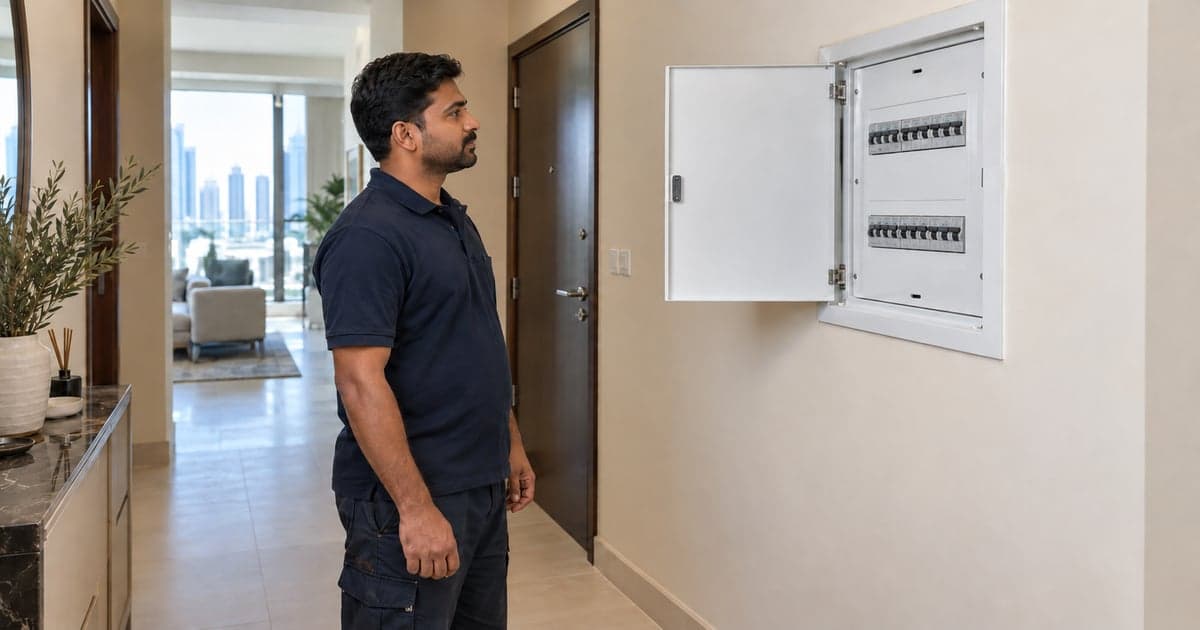
- If a safe ordinary view is available, share the closed board exterior, visible circuit labels or affected appliance. Do not remove covers, enter electrical rooms or approach wet/damaged equipment for a photo.
- Crop or blur names, addresses, phone numbers, unit numbers, account numbers, barcodes, serial labels and unrelated faces. Put contact and access information in private booking fields.
- Ask each provider for the same diagnostic allowance, no-fault-found terms, extra-work approval, repair specification, testing, VAT and visit-credit policy.
If the trip is associated with an AC, the electrical supply and the equipment may need different checks; see the Dubai AC repair scope guide after the electrician establishes the safe route. If water is involved, resolving the electrical hazard does not repair a hidden leak: the leak-detection guide explains that separate investigation. Avoid paying two teams to repeat the same work without a coordinated brief.
Compare the same power-trip repair scope
Send one clear symptom brief and compare written diagnostic and repair terms for free. Check what the visit includes, what is credited and what remains unpriced before approving work. For an active hazard, seek urgent help instead of waiting for quotes.
Compare Quotes for FreeFrequently asked questions
How much does power-trip repair cost in Dubai?
A diagnostic visit and a completed repair are different purchases. Reviewed provider pages include AED 150–300 assessment bands and fault-finding services from AED 349 per call-out. An older still-public provider guide lists AED 200–450 for one standard MCB replacement, but that does not price an unexplained recurring trip. Ask for a current scope-specific quote.
Does a tripping breaker mean the breaker is faulty?
Not necessarily. The protective device may be responding to a circuit, appliance, load or moisture-related fault. A competent electrician needs to determine the cause before specifying a repair. Replacing the breaker without that assessment may leave the original problem unresolved.
Can I keep resetting it until the electrician arrives?
No. Repeated resets do not resolve the cause and can re-energise a faulty circuit. Stop using affected equipment and seek professional guidance. Smoke, sparks, heat, shocks or water near electrical equipment need urgent attention; do not wait for a normal quote comparison.
Should I contact DEWA or a private electrician?
For a supply incident or wider interruption, use DEWA Smart Response or 991 and inform building management. For an internal installation fault, a competent private maintenance provider may be needed. Shared electrical rooms and meter equipment are not resident access areas. Confirm any attendance charges.
Why did the electrician charge for diagnosis if no part was replaced?
Investigation is work in its own right. What you owe depends on the agreed visit allowance, additional time and no-fault-found terms. Ask for observations and the next proposed step. A repair discount or visit credit applies only if its written conditions are met.
What if the trip does not happen during the visit?
Provide the incident log without reproducing the fault. Agree whether further investigation, a return visit or specialist equipment is justified, what evidence it should produce and its cost before authorising it. A quiet period alone does not prove that the underlying problem has disappeared.
Can an ordinary electrician fix a trip associated with my AC or water heater?
An electrician can assess the electrical supply and protection within the agreed competence and scope. An appliance or AC fault may then require the relevant specialist. Ask who owns each investigation and whether any first-visit findings can be shared so the second team does not start from zero.
Sources and review method
Reviewed 16 September 2026 by Bestimate Editorial Team. The provider table keeps advertised units and publication caveats separate; it is not a representative market survey, live quotation or provider endorsement. Manufacturer, utility and DEWA sources support the safety boundaries and terminology. The calculator uses only entered prices, with no assumed fault probability, urgency multiplier or automatic breaker replacement.