Quick answer
For a three-seater, the Dubai provider pages reviewed on 16 September 2026 span AED 900–7,000 for advertised reupholstery, with very different materials and scope. A fabric-only refresh is not the same job as new foam, suspension and frame repairs. Obtain a whole-sofa specification, then compare its complete cost with an actual replacement—not a fixed percentage rule.
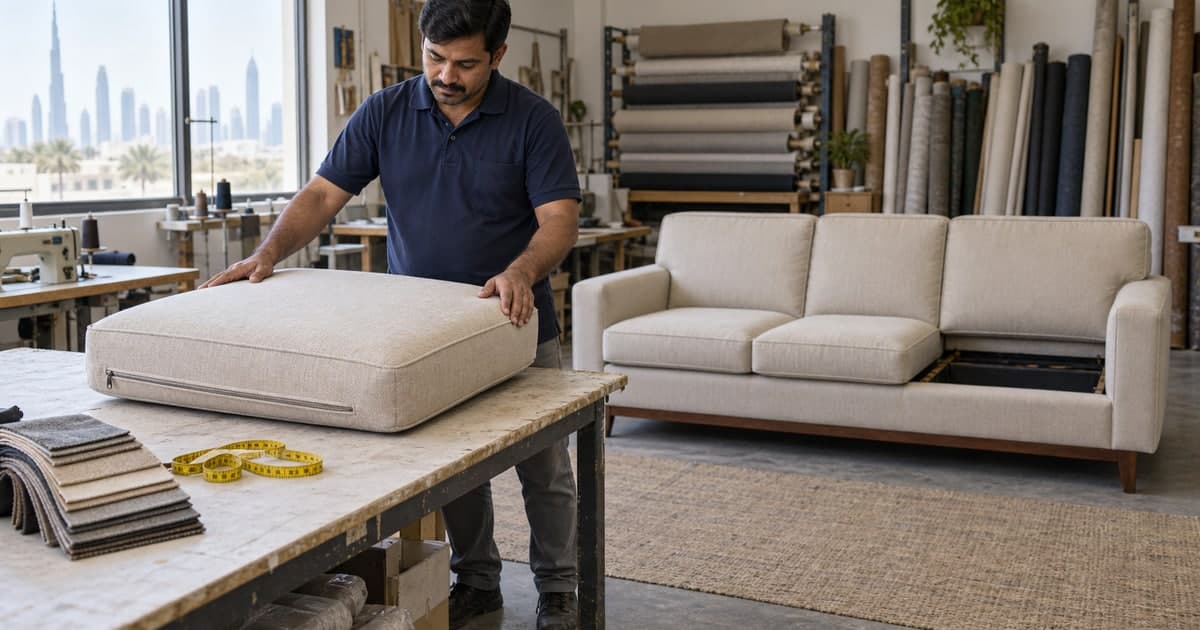
A sofa can look tired for several different reasons: dirty upholstery, worn covering, flattened cushions or movement in the frame. Paying for new fabric will not resolve every one of those problems. Start by deciding what you want to keep—the dimensions, seat depth, comfort, shape or sentimental value—and what genuinely needs changing.
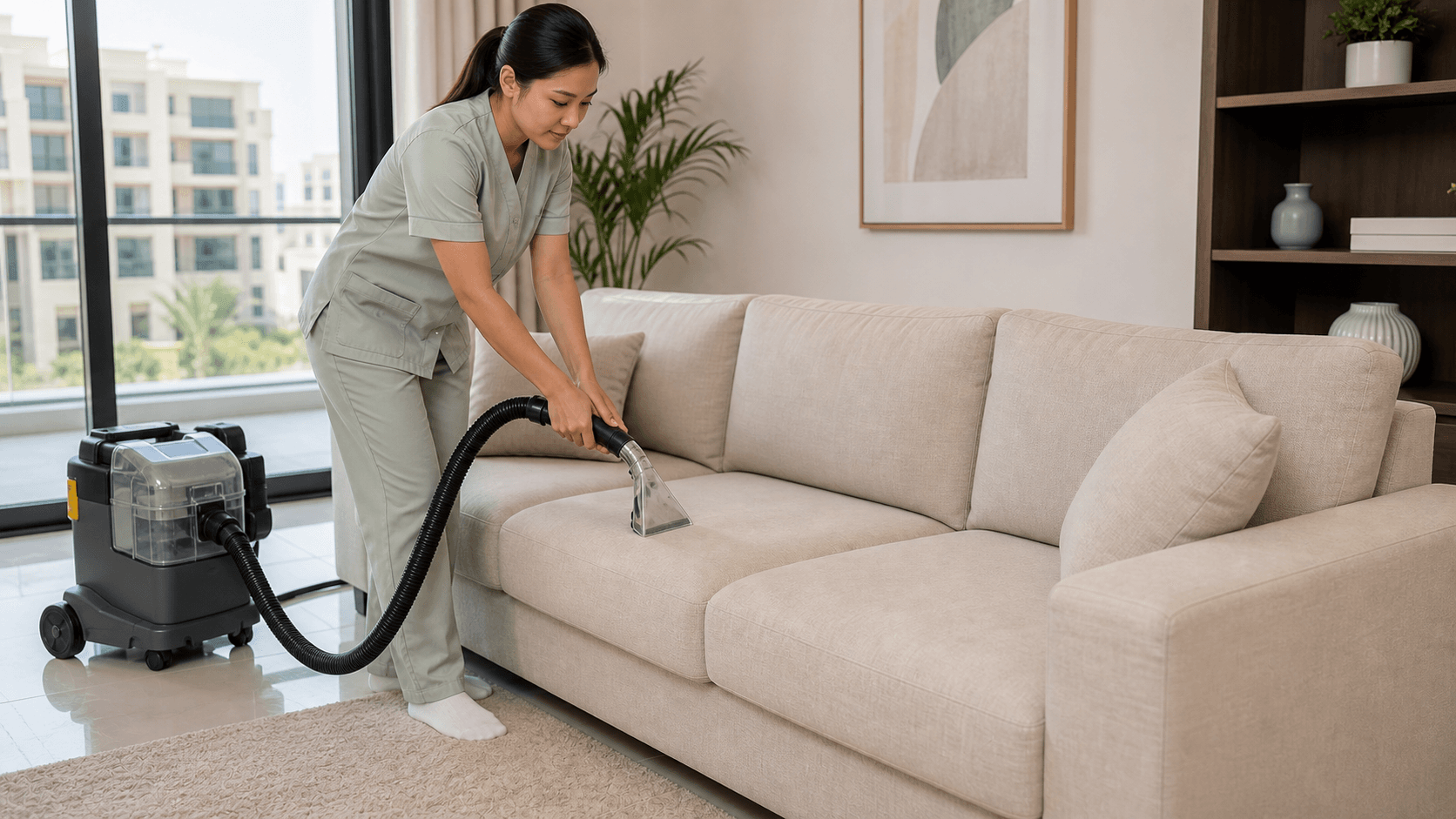
This guide covers sofa reupholstery in Dubai: replacing coverings and agreeing any associated cushion or structural work. If the covering is intact and the main issue is dirt or removable staining, first compare the separate sofa-cleaning options and quote units. Cleaning and reupholstery should not be presented as interchangeable services.
Dubai prices: compare the job, not just the number
These are indicative AED planning references from public provider pages, not quotes or Bestimate transaction averages. Your actual cost depends on dimensions, chosen material, upholstery construction, condition, access and the written repair scope. The table preserves each advertiser’s unit instead of merging them into a misleading average.
| Published provider reference | Advertised AED price and unit | What needs checking |
|---|---|---|
| RepairSofaDubai: covering change | 600–900 per three-seater, fabric change only | Different from its full-reupholstery row; confirm retained foam and repairs. |
| RepairSofaDubai: full fabric reupholstery | 900–1,400 per three-seater | Page says material, labour and collection/return included. Its FAQ instead says 800–1,200; obtain a current written total. |
| RepairSofaDubai: cushion work | 150–300 per seat, fabric + foam | A cushion/seat unit is not the arms, back and body of a complete sofa. |
| Karnak: fabric reupholstery tiers | 1,400–5,000 per three-seater; 2,500–9,000 per L-shape | Materials and labour stated; delivery/installation described as free. Confirm collection, foam grade and structural scope. |
| Adams: reupholstery guide | 3,500–7,000 per three-seater; 6,000–12,000 per large corner sofa | Collection/return stated as included; fabric, fillings and complexity change the quotation. |
VAT is not explicit in the price sections used above. Do not assume that “all-inclusive” resolves every tax or access question. The wide spread is a reason to request specifications, not proof that the lowest or highest provider is better. A large sectional also cannot be priced reliably by multiplying a three-seater figure.
Compare restoration against a real replacement
The calculator below uses your written prices, not an automatic market rate. Choose a whole-sofa package or enter fabric, foam, labour, frame work and transport separately. In package mode, mark covered items as included so they are not counted twice. In itemised mode, use a quoted material total or the upholsterer’s measured fabric requirement multiplied by its price per metre.
Add a specific replacement sofa plus delivery, assembly and old-sofa removal on the other side. Unknown charges stay unknown: the tool withholds a complete comparison until scope and VAT terms are confirmed. It does not predict remaining life, hidden damage or future repairs, and it never invents fabric length from seat count. These are planning calculations, not quotations.
Open the full-screen calculator and methodology.
Clean, repair, re-cover or replace?
| What you observe | First scope to discuss | Important boundary |
|---|---|---|
| Intact fabric, acceptable comfort, dirt or staining | Material-appropriate cleaning assessment | Cleaning is not a promise to remove every stain or restore faded colour. |
| One open seam, damaged panel or local cushion problem | Targeted repair or cushion replacement | Matching an aged covering may be difficult; approve any visible mismatch. |
| Worn covering, but a shape and seat you want to retain | Re-covering with documented fabric and retained fillings | Specify which panels, backs, arms and loose cushions are covered. |
| Sagging, uneven support, creaking or loose joints | Inspection of foam, suspension and frame before recovering | Fresh fabric can conceal unresolved damage; agree repair approval first. |
| Wrong size or comfort, serious unresolved damage, poor fit for your needs | Compare replacement with the inspected restoration scope | Purchase price alone does not capture delivery, disposal, downtime or fit. |
These observations help describe a job; they do not diagnose unseen furniture. Avoid using an unstable sofa or testing a broken mechanism under load. Ask a repairer to assess loose structural parts or exposed sharp components. Do not dismantle a powered recliner, modify its wiring or remove upholstery to investigate it yourself.
If transport is excluded from the restoration quote, the single-item moving cost guide can help you compare collection and return access separately. Check whether the upholsterer already covers either journey before adding another charge.
What should be inside a reupholstery quote?
The word “full” is not a specification. Ask whether the contractor strips the old covering, replaces the underside dust cover, rebuilds cushion interiors, repairs seams and zips, and reinstalls decorative details. Identify every retained part. Seat cushions, back cushions, scatter cushions and an ottoman are separate pieces even when they belong to the same suite.
| Quote line | Specify in writing | Common comparison mistake |
|---|---|---|
| Covering material | Supplier, collection/code, colour, composition, fabric width and approved sample | Comparing “premium fabric” without identifying the actual textile. |
| Fabric quantity | Measured cutting allowance, pattern direction, repeat and charge basis | Treating a price per running metre as a finished-sofa price. |
| Cushion interiors | Which cushions change, foam grade/density, firmness, thickness and wrap | Assuming all cushions are renewed when only seat foam is included. |
| Labour and finish | Removal, sewing, fitting, piping, buttons, zips, underside and final appearance | Adding labour again to a package that already contains it. |
| Frame and suspension | Inspection, specific repair items and approval process for hidden damage | Calling new foam a repair for failed webbing or frame joints. |
| Transport and access | Both journeys, handling, dismantling/reassembly, stairs and waiting | Reading free delivery as a promise of free collection and every access extra. |
If additional damage can only be seen after stripping, set a decision point: the workshop sends photos, explains the proposed work and obtains written approval before proceeding. Ask what happens if you decline the revised scope, including any inspection, stripping or return charges. A vague permission to “do whatever is needed” makes later comparisons almost impossible.
Choosing fabric and foam without marketing shortcuts
For fabric, ask for the actual product sheet and care instructions. Kvadrat’s upholstery documentation reports abrasion resistance, pilling and lightfastness separately: they answer different questions. A good abrasion figure does not tell you whether a material suits a sunny position, a particular cleaning method or the appearance you want.
The Association for Contract Textiles cautions that twice the abrasion cycles does not mean twice the service life. Compare the named test method, not an isolated “rub count”, and avoid translating test results into guaranteed years. For a bright Dubai room, discuss exposure through glazing and ask whether the selected colour and textile are suitable for that position. Indoor and outdoor use should be confirmed separately.
Foam needs more than the label “high density”. The Polyurethane Foam Association explains that density and firmness are independent: a denser foam can feel soft, and a lower-density foam can feel firm. Ask for the proposed grade, density with units, firmness specification, thickness and cushion construction. Try a representative cushion if available; a small sample alone will not reproduce the complete sofa seat.
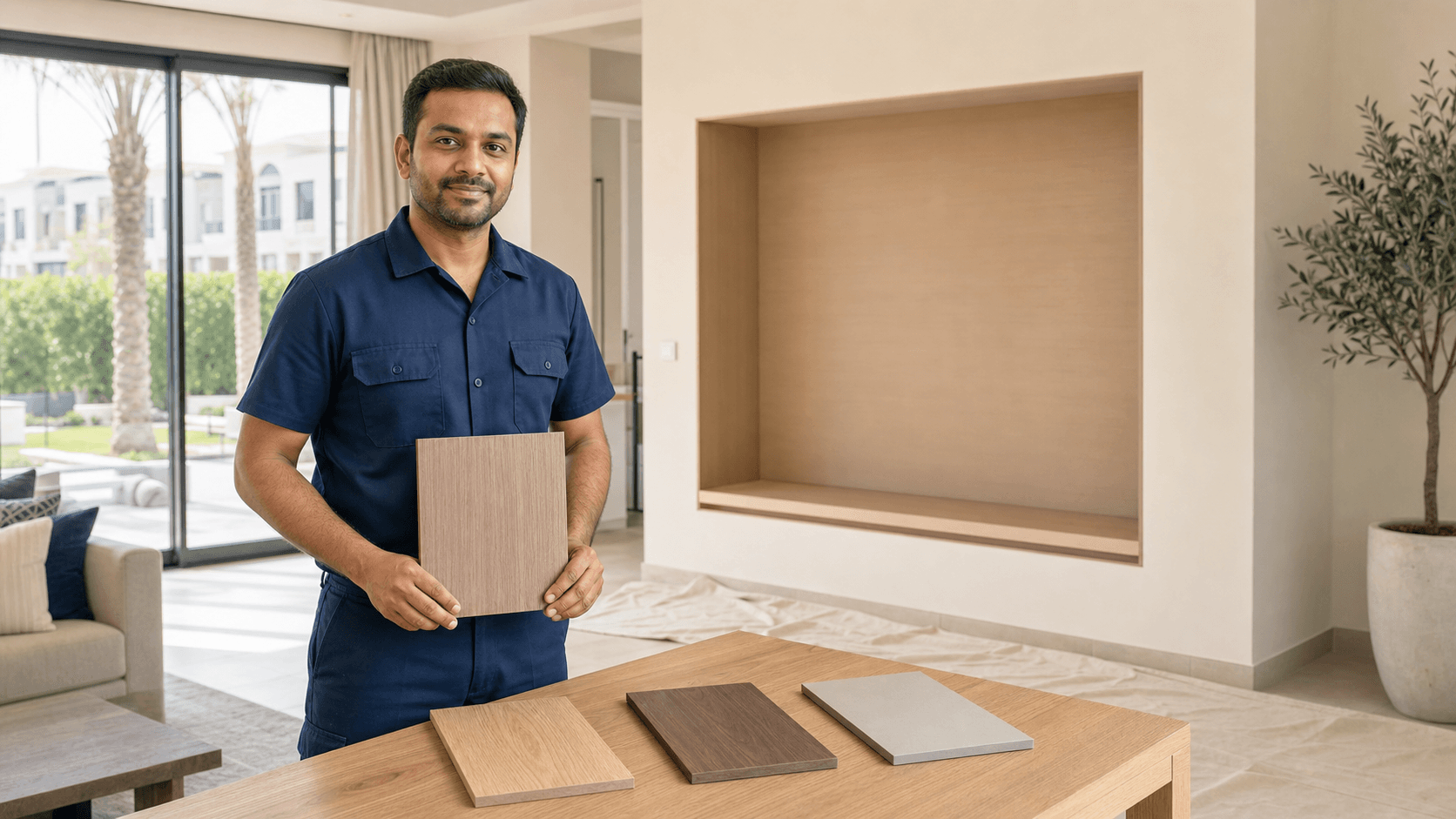
Approve a physical fabric sample in your room, including under evening lighting, and keep the code on the order. Confirm whether removable covers are actually washable under the manufacturer’s care instructions; a zip does not itself establish washability. If you supply the fabric, agree who measures it, checks suitability and carries the risk of shortages or defects before buying it.
The Dubai logistics that change the usable total
Ask building management which booking, access-pass or loading arrangements apply to furniture collection and return. Requirements vary; do not assume a standard NOC applies everywhere. Share lift and doorway measurements, stairs, long carrying distances and any restriction on working hours privately with the provider. Confirm whether modules or legs must be removed and who reinstalls them.
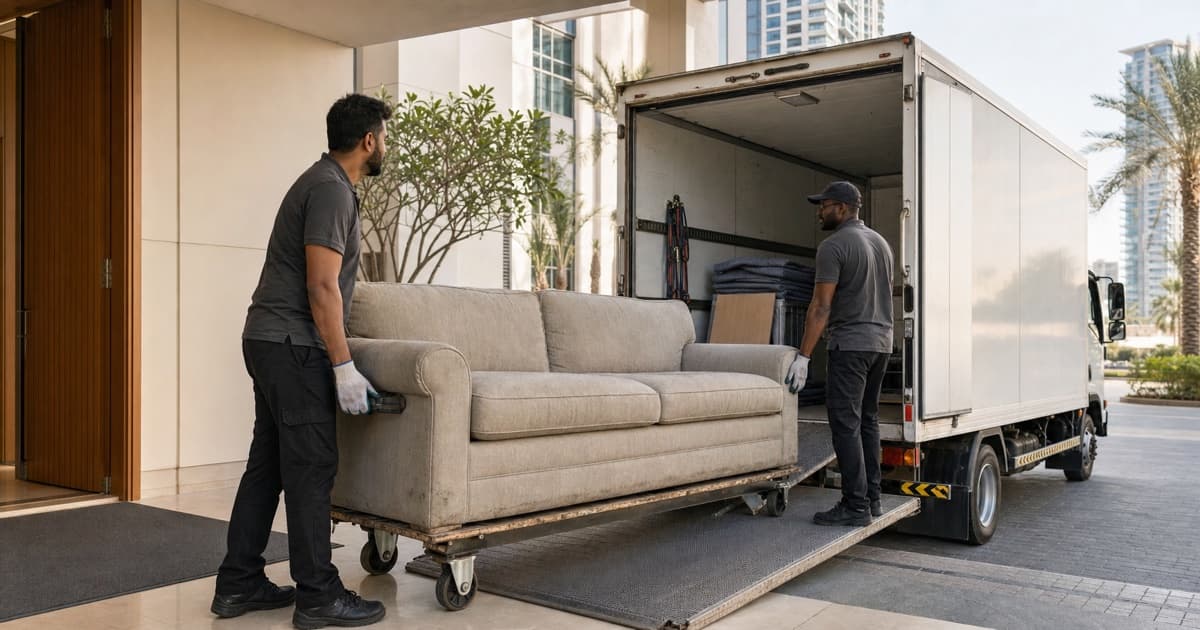
Collection included by the upholsterer is normally simpler to compare than an unpriced transport allowance. If transport is excluded, obtain a separate single-item moving quote that includes protective wrapping and both ends of the journey. Avoid booking a second transport service when the upholstery package already includes it.
Get dates for fabric availability, collection, workshop completion and return—not only an estimate of sewing time. Imported or unavailable fabric, approval of hidden repairs and workshop scheduling can change the period without seating. Agree what happens if the chosen fabric is unavailable; a similar-looking substitute should not arrive without your approval.
A fair restore-versus-replace comparison
Use the following as an arithmetic illustration, not a Dubai price forecast. Assume a written package of AED 2,000 includes fabric, foam, labour and both transport journeys, with frame work confirmed unnecessary and no other charges. If it excludes 5% VAT, the restoration total is AED 2,100. A replacement priced at AED 3,500 including VAT, plus AED 150 delivery and AED 100 removal on the same tax basis, totals AED 3,750.
| Illustrative option | Complete entered total | What the number does not prove |
|---|---|---|
| Restore: 2,000 package × 1.05 | AED 2,100 | Condition, fabric identity and workmanship still need checking. |
| Replace: 3,500 + 150 + 100 | AED 3,750 | The new option must have the size, comfort and features you actually want. |
| Difference on this entered scope | AED 1,650; restoration is 56% of replacement | 56% is not an instruction to accept or reject restoration. |
The standard UAE VAT rate is 5%; apply it according to the supplier’s written tax terms, not automatically to every price twice. There is no universal “replace above 50%” rule. You might pay more to keep a particularly suitable piece, or choose a lower-priced replacement because the original no longer fits your home. Compare written warranty coverage and exclusions, not only warranty duration.
Send one brief; inspect the returned sofa against it
- Record overall width, depth and height, the sectional layout, removable modules and every cushion or ottoman included. Mention whether it is a sofa bed or recliner.
- Photograph the whole sofa and close-ups of wear, seams and sagging. Crop or blur names, addresses, phone numbers, unit numbers, delivery labels, barcodes, serial labels and unrelated faces. Put contact and access details in private booking fields.
- Describe your preferred finish and comfort, what should stay unchanged, and the target return date. Ask for material samples, line-item exclusions and a fixed total after assessment.
- Before collection, record existing condition and agree payment milestones, hidden-damage approvals and responsibility during transport. Keep the written order and fabric code.
- On return, compare panel coverage, seams, pattern alignment, cushion fit, legs and approved repairs against the order. Check ordinary operation with the provider and raise discrepancies before signing off, following the agreed payment terms.
Compare the same sofa restoration brief
Tell providers which covering, cushions and repairs you want assessed. Compare complete written scopes, material specifications and collection terms before deciding whether to restore or replace.
Compare Quotes for FreeFrequently asked questions
How much does sofa reupholstery cost in Dubai?
The reviewed advertisements range from AED 900–7,000 for a whole three-seater reupholstery, across different providers and specifications. Fabric-change-only and per-seat cushion jobs are smaller scopes. Use the provider table as context, then obtain a measured written quotation with VAT and transport confirmed.
Can I multiply a per-seat price by three?
Only when the provider explicitly defines that rate as the complete work for each of those seats. A cushion fabric-and-foam price may exclude the sofa body, arms and back. Ask for the whole-sofa total and a list of included pieces.
Does reupholstery include new foam?
Not automatically. Some quotes retain existing interiors, some change seat foam only, and others rebuild seat and back cushions. Confirm the quantity, grade, density, firmness, thickness and wrap separately from the covering material.
How many metres of fabric will my sofa need?
Have the upholsterer measure it for the selected fabric width and pattern. Arms, cushion faces, repeats, directional fabrics and decorative details affect the cutting requirement. This guide and calculator deliberately do not infer metres from seat count.
Is reupholstery always cheaper than a new sofa?
No. Compare the assessed restoration total with a specific replacement that meets your needs, including tax, delivery and removal. Condition, comfort, fit and sentimental value also matter. A percentage of replacement cost is useful arithmetic, not a universal decision threshold.
Can cleaning fix worn or peeling upholstery?
Cleaning addresses soil using a suitable method; it does not replace missing covering or repair a failed frame. Ask a specialist to identify the material and whether a local repair, panel replacement or complete re-cover is appropriate. Do not assume every leather-look material is genuine leather.
How long will the job take?
Ask the selected workshop for dated collection and return commitments after confirming stock and repair scope. A standard advertised turnaround may not include fabric ordering, building access delays or newly discovered repairs. Arrange seating around the agreed schedule rather than a general online estimate.
What if damage is found after the old cover is removed?
The quotation should require photos, a revised scope and your written approval before extra work. Agree in advance what you owe if you stop, including stripping and return transport. Do not treat an unknown repair as zero in your comparison.
Sources and review method
Reviewed 16 September 2026 by Bestimate Editorial Team. Public Dubai/UAE provider advertisements establish the scope-specific planning references above; they are not booking data, endorsements or a representative market average. We retained the visible table units and disclosed a conflicting FAQ rather than silently choosing a preferred price. VAT, material selection and unseen repairs remain quotation checks.
Technical explanations use PFA foam guidance, Kvadrat textile documentation and ACT abrasion guidance. The calculator performs arithmetic on user-entered terms; it adds no assumed per-seat rates, lifespan, fabric allowance or automatic repair-versus-replace threshold.