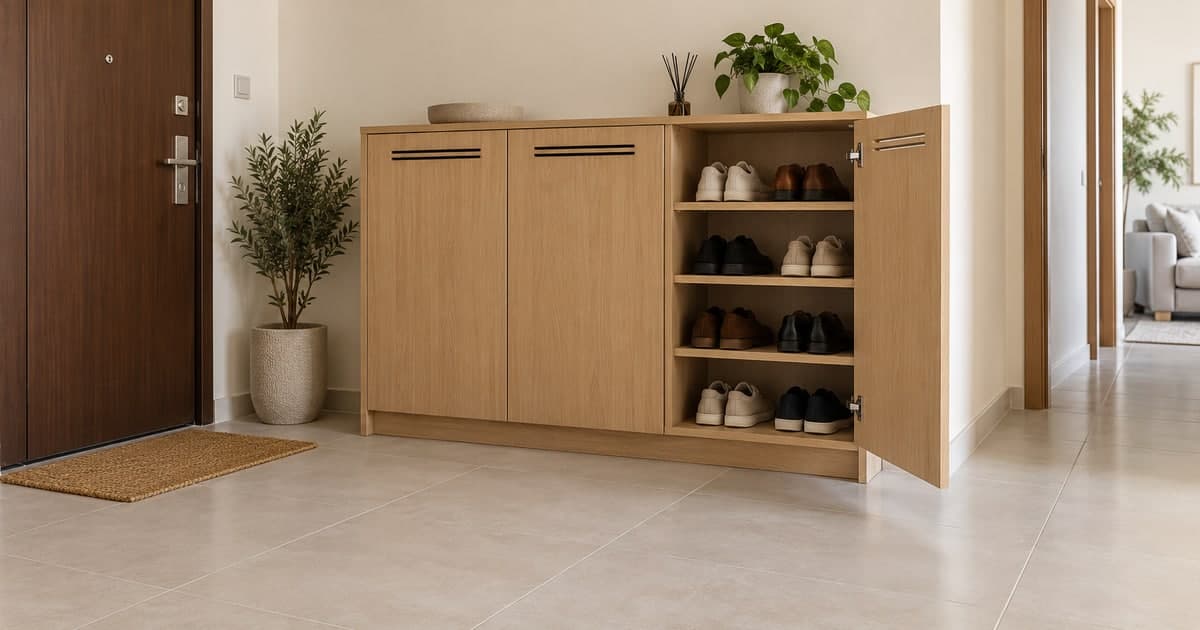
A custom shoe cabinet in Dubai should be designed from your largest footwear and the usable hallway space—not a promised pair count. Agree the external projection, internal shelf or tray dimensions, opening clearance, ventilation and wall-fixing plan before approving the drawing. A cabinet can fit the wall perfectly and still fail when the front door opens or a pair of boots goes inside.
This is a joinery guide for a new made-to-measure cabinet. If you mainly need to sort shoes and accessories in existing storage, use the closet organisation guide. Full clothing storage has a different brief, covered in our custom wardrobes and closets guide.
How much does a custom shoe cabinet cost?
Custom work needs a measured quotation with materials, fittings and installation stated. Bamboo Woodworks' Dubai service page identifies cabinet size, drawer type and finish as price drivers and describes both supply-only and fitted work. It does not establish a standard price for your cabinet.
For scale only, checked on 18 October 2026, IKEA UAE lists the STÄLL 96 × 17 × 90 cm shoe cabinet at AED 499 including VAT. This is a standard-size product, not a bespoke installed quotation. Its stated capacity is approximately eight pairs; that is model-specific, not a design formula for custom cabinetry. Delivery, assembly and fixing costs must be checked separately.
| Layout | Useful when | Test before approval |
|---|---|---|
| Slim tilt-out compartments | Closed projection is the main constraint | Largest shoes fit the mechanism; fronts open clear of the walkway |
| Shelves behind hinged doors | Mixed footwear needs adjustable clear heights | Usable depth, door swing and hinge obstruction |
| Pull-out trays or drawers | You want easier access to deeper storage | Full extension, rated load and floor space while open |
| Bench with shoe storage | Putting shoes on comfortably is part of the brief | Seat structure and intended load explicitly designed, not assumed |
Compare your actual cabinet quotes
Use the same approved drawing and footwear requirements for both carpenters. Enter measuring/design, carcass and fronts, specified hardware, ventilation and internal fittings, delivery/installation and any making-good work. Count a full cabinet package once, and mark its included parts rather than adding them again.
Compare fitted shoe cabinets against the same approved drawing, usable footwear capacity, ventilation and wall-fixing scope.
Open the full custom shoe cabinet quote comparison. Use written prices: unknown essentials remain unresolved and a comparable difference appears only after both scopes are confirmed.
The tool compares reader-entered amounts; it does not estimate a fair market price from cabinet width. Unknown hardware, fixing or VAT charges remain unresolved. A lower total for fewer drawers, a different finish or supply-only work is not a like-for-like saving.
Work backwards from real shoes and the available passage
Make a short inventory of everyday pairs, occasional shoes, boots and unusually large trainers. Give the carpenter representative examples to test, or their actual dimensions with photographs. Shoe size alone does not describe the sole length, width or boot height. Decide whether some occasional pairs can stay elsewhere before committing the whole wall to storage.
Ask the drawing to distinguish external depth from clear usable internal depth. Doors, backs, hinges, runners and tilted inserts consume space. A shallow product using a tilt-out mechanism is not evidence that the same depth works for horizontal shelves. Likewise, an advertised pair count assumes a particular mix and arrangement of shoes.
Mark the proposed cabinet footprint temporarily on the floor and check the front door, nearby room doors and cupboard access. Then check the footprint with cabinet doors or trays open. Include skirting boards, switches, sockets and existing access panels in the survey. Do not place a cabinet in a shared corridor or obstruct an escape route; confirm the property's requirements with management where relevant.
Make ventilation and cleaning part of the drawing
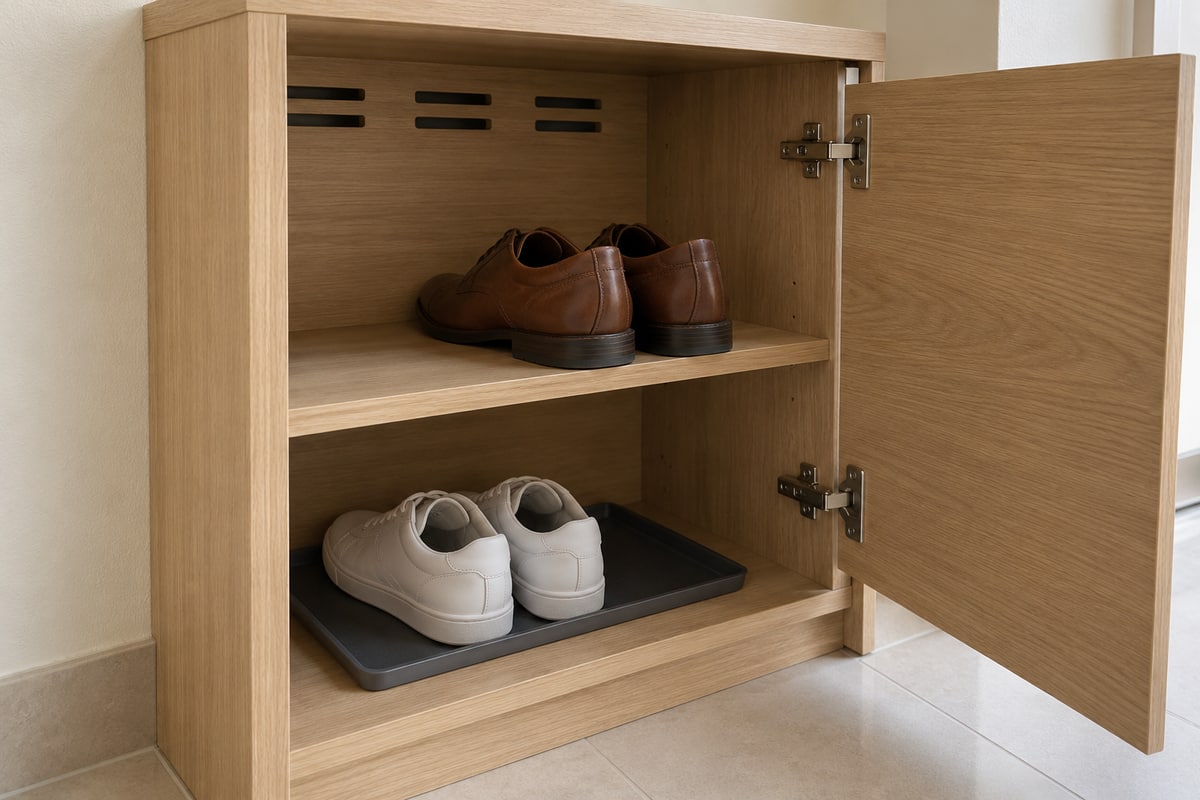
Bamboo Woodworks describes discreet vents and wipe-clean finishes in its shoe-cabinet service; IKEA's cited shoe cabinet also specifically provides ventilation. The practical brief is to show an airflow path rather than merely write “ventilated” on the quote. Ask where openings sit and whether the chosen backing, wall position or stored items could block them.
A louvred or slatted front may make contents more visible and collect dust differently from a smooth door. A discreet vent can preserve a cleaner appearance, but its design needs to be intentional. Choose removable or accessible shelves so grit can be cleaned from corners. Discuss a separate removable tray for wet or sandy footwear, with materials and edges suited to that use.
Ventilation is not a guarantee against smells or mould, and a cabinet is not a drying appliance. Let wet shoes dry according to their care instructions before closed storage. Do not add electrical fans, UV devices or fragrancing systems casually; those introduce separate suitability, maintenance and installation questions.
Put these details into the written specification
| Item | Specify | Common omission |
|---|---|---|
| Carcass and finish | Board/material, exposed edges, finish sample and back construction | Unfinished hidden edges or a different internal finish |
| Storage hardware | Exact hinges, runners or tilt mechanism and intended loads | Unpriced “soft-close upgrade” or reduced clear space |
| Ventilation and interiors | Opening positions, shelf heights, adjustability and removable trays | Decorative vents blocked by backing or shoes |
| Installation | Wall assessment, fixing, scribing, access and making good | Supply-only price mistaken for completed fitting |
Keep board type and finish specific rather than accepting “premium wood” as a complete description. Ask how cut edges and areas near floor cleaning will be protected. Moisture-resistant material is not permission to leave standing water against the cabinet. Approve a physical finish sample when colour matching matters; a phone photograph is not a controlled colour reference.
Safe fixing and a useful handover test
IKEA's general manufacturer tip-over guidance, published on its Saudi-facing site, stresses securing furniture to the wall. This is manufacturer safety advice, not a statement of Dubai law. Have the installer identify the wall construction and suitable fixing arrangement for your cabinet, following the product/design instructions and checking concealed services. A heavy cabinet is not automatically stable, and a wall-hung unit needs a designed support detail.
Confirm landlord or management permission for permanent fixing where required. Do not accept a unit left unsecured because “the screws were not included”. Keep children away from incomplete furniture, and do not treat a cabinet top as a seat unless it was designed for that purpose.
At handover, test your largest pairs in the agreed compartments, open every door and tray, check nearby door movement and verify the fixing and vent details. Confirm delivery, installation, adjustment and warranty responsibilities in writing. The custom carpentry service is the relevant route for the measured cabinet brief.
Have your requirements ready? Compare custom shoe cabinets quotes with a free request, or check the matching service. Confirm the assessed scope and availability before booking.
Frequently asked questions
What depth should a shoe cabinet be?
There is no universal depth. It depends on your footwear, shelf orientation, mechanism and hallway clearance. Ask for both external and usable internal dimensions and test representative pairs.
Can a very slim cabinet hold large trainers?
Possibly, but do not infer that from the external depth or advertised pair count. Have the maker test the actual tilt mechanism or compartment with your largest pair before fabrication.
Do shoe cabinets need ventilation?
Include an intentional airflow path in the design, especially for closed storage. Ventilation does not replace drying wet footwear or keeping the cabinet clean.
Is a freestanding cabinet safe without wall fixing?
Follow the cabinet's instructions and the installer's assessed fixing plan. Do not assume weight alone prevents tip-over, particularly with open drawers or children nearby.
Can the cabinet include a bench?
Yes, if seating is part of the structural design and quotation. Specify intended use and load; an ordinary cabinet top should not be assumed suitable for sitting.
Sources and review notes
Reviewed 18 October 2026 by Bestimate Editorial Team. Sources: Bamboo Woodworks measured cabinetry scope; IKEA UAE STÄLL dimensions, ventilation and retail price; IKEA general tip-over guidance on its Saudi-facing site. The retail example is not a custom-joinery price range. No provider endorsement, engineering approval or documented customer installation is claimed.