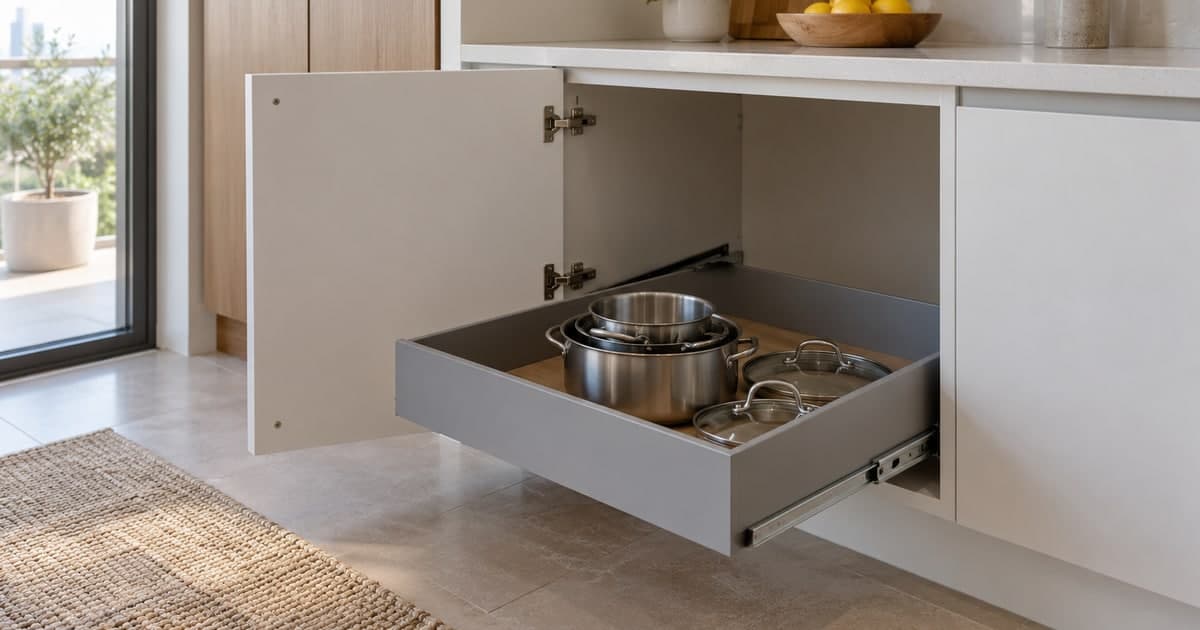
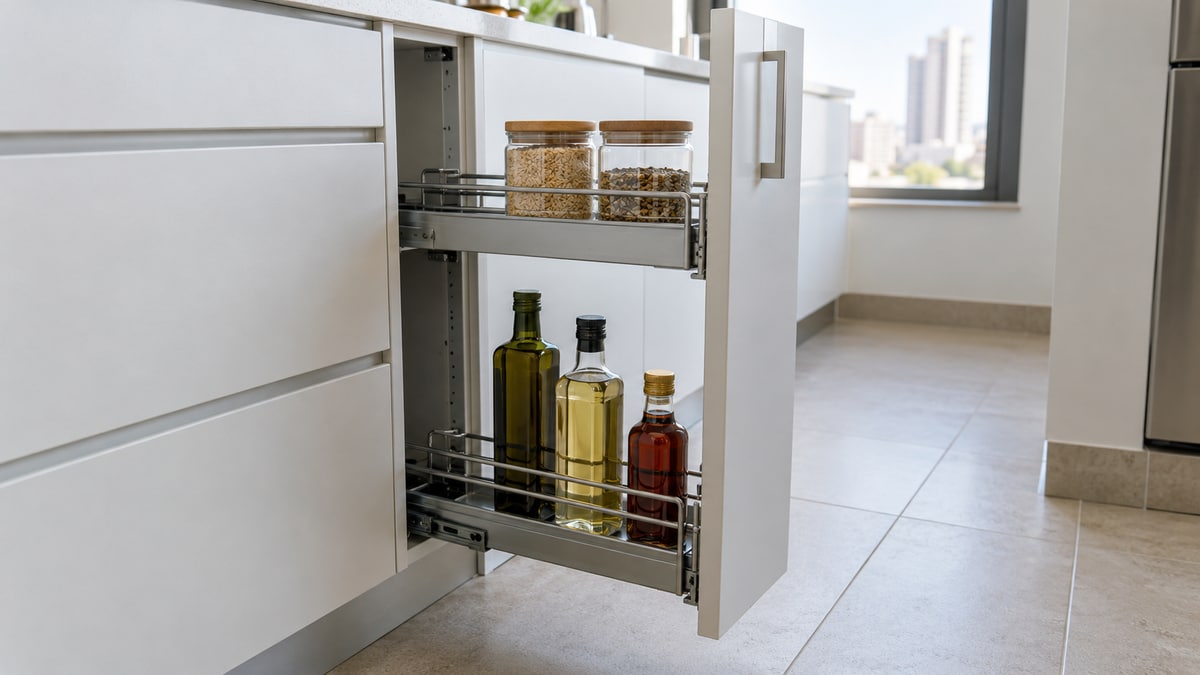
Kitchen pull-out storage brings the contents of a deep cabinet towards you. Retrofitting it in a Dubai home can be worthwhile when the cabinet boxes are sound but the back of a shelf is hard to reach. The key is choosing a mechanism that fits the real interior, clears the door and suits the things you store—not buying a basket that happens to match the cabinet’s outside width.
Quick answer: assess the cabinet before choosing the mechanism
- Measure usable internal space, including hinges, door opening, pipes and other obstructions.
- Choose between independent inner drawers, a front-attached pull-out and a specialised corner mechanism.
- Confirm the exact model, tray count, supplied joinery and load limits in the quote.
- Resolve swollen boards, loose fixings or leaks before adding heavier moving storage.
This is a hardware-and-joinery upgrade, not a pantry-organising session or a complete kitchen refit. We have not verified a consistent fitted AED price range: basket-only offers, complete mechanisms and bespoke drawer construction have different inclusions. Ask for a measured written quotation per agreed cabinet set, with VAT, assessment, installation and repairs separated. The matching service is kitchen cabinet installation.
Choose the movement that suits the contents
| Storage option | Best question to ask | Important trade-off |
|---|---|---|
| Independent inner drawers behind a hinged door | Can I open only the drawer I need and see its contents? | The hinged door must clear every drawer and runner |
| Front-attached base pull-out | Can the whole loaded unit move comfortably in this aisle? | One pull moves the connected trays and their contents |
| Tall pantry pull-out | Does one moving assembly suit the height and stored load? | Model-specific support, fixing and load requirements matter |
| Corner mechanism | What part of the corner becomes accessible with the door open? | The mechanism occupies space and needs an unobstructed movement envelope |
| Retained shelf with removable containers | Would a simple removable container solve the access problem? | Less construction, but the shelf depth and lifting task remain |
Blum’s SPACE TOWER concept uses separate full-extension inner drawers, while Kesseböhmer’s DISPENSA junior demonstrates a connected base-unit pull-out accessible from both sides. These illustrate different movements; they are not interchangeable specifications or endorsements for every retained cabinet.
List what will go inside before choosing the mechanism. Tall oil bottles need usable height, heavy pans need a suitable rated assembly, and small packets need containment that stops them falling through or behind a tray. Ask for the internal storage dimensions after hardware and drawer sides are installed. A mechanism can improve access while reducing some usable volume; that may be a good trade, but it should be deliberate.
Outside cabinet width is not the fitting size
Ask the fitter to measure clear internal width, depth and height, the door opening and the required travel into the room. Photographs should show hinges, shelves, dividers, sockets, pipework and the back panel. A nominal cabinet width on a product page does not replace its technical drawing or an onsite check.
Door clearance is particularly easy to miss. Hettich’s current Sensys range describes a wide-angle hinge that allows internal drawers without spacer profiles. The practical lesson is to check the complete door-and-drawer geometry. A different hinge, spacer or narrower drawer may be required; a wide opening-angle label alone is not proof that your proposed drawer will clear.
Check the aisle too. Show how the dishwasher, oven and adjacent doors open, and where someone stands while using the pull-out. For an under-sink proposal, access to valves and plumbing must remain practical. Do not accept an arrangement that traps a service point or requires moving pipework that no one has assessed or priced.
Old cabinet condition and load claims need care
Strong new runners do not strengthen damaged cabinet boards. Ask the installer to inspect the sides, base, joints and attachment points, especially where old screws have loosened or moisture has affected the material. If there is an active leak or soft, swollen board, address that condition before commissioning the storage upgrade. The kitchen cabinet repair guide covers that separate decision.
Use the exact manufacturer’s limits for the selected model and installed configuration. Kesseböhmer publishes a tray limit for the referenced base pull-out; Blum describes capacities for specified drawer systems. Neither is a universal allowance for all baskets or existing cabinets. Ask whether a quoted capacity refers to each tray, the complete moving assembly, or includes the drawer’s own weight. Do not add several headline capacities together unless the technical documentation permits it.
Soft-close is useful, but it does not establish load capacity, full extension or repairability. Ask how the mechanism is adjusted, what parts can be replaced, and who provides service if a runner or damper fails. A product warranty and labour coverage are separate commitments; request both in writing without assuming one implies the other.
What should a fitted pull-out quote contain?
| Quote line | Useful detail | Potential omission |
|---|---|---|
| Mechanism | Exact model, cabinet assignment, tray count, finish and documented limits | A generic “premium basket” with no identifiable parts |
| Joinery | Drawer boxes, wooden bases/backs, fronts, dividers and edge finishing | Hardware-only kit mistaken for a complete drawer |
| Compatibility work | Hinges, spacers, shelf removal and assessed strengthening | Drawer collides with the open door after installation |
| Fitting and adjustment | Fixing method, alignment, movement checks and user handover | Supply-only price compared with fitted work |
| Completion | Disposal, visible-hole repairs, finish matching and callback terms | Old shelf holes and damaged edges left outside the scope |
Blum’s regional catalogue example explicitly lists wooden components excluded from particular hardware sets. It is not a UAE offer, but it illustrates why “complete hardware” need not mean a finished cabinet interior. Ask the local supplier to state what is physically delivered and who makes any remaining parts.
Compare two pull-out storage proposals
Use the same cabinets, mechanism types and tray schedule in both quotations. The tool below compares your actual prices for hardware, joinery, compatibility work, fitting and completion. Enter a whole cabinet set once; do not multiply that amount by the number of trays it already includes. Keep unpriced repairs unknown, and apply VAT only according to the written quote. It cannot certify cabinet strength or decide which mechanism fits.
Compare retrofitted kitchen pull-outs using the same cabinets and hardware schedule. A basket-only price is not a fitted storage system.
Open the full kitchen pull-out storage quote comparison. Use written prices: unknown essentials remain unresolved and a comparable difference appears only after both scopes are confirmed.
Prepare a useful measurement visit
Send a wide kitchen view, each target cabinet with the door open, the interior obstructions, approximate dimensions and a photograph of the items you want to store. Explain the problem—bending to reach pans, forgotten food at the back, or a difficult corner—rather than requesting “more storage” alone. State whether you want to retain existing fronts and whether finish matching is important.
At the visit, agree an annotated cabinet schedule with one specification per opening. Ask for a sample or demonstration of the proposed movement. At handover, have the installer demonstrate operation with representative contents within the confirmed limits, check clearances, and explain loading and adjustment instructions. If the problem is mainly clutter rather than access, the kitchen and pantry organisation guide may solve it without new mechanisms.
Have your requirements ready? Compare kitchen pull-out storage quotes with a free request, or check the matching service. Confirm the assessed scope and availability before booking.
Frequently asked questions
Can pull-outs be fitted to an existing kitchen?
Often, if the cabinet condition, dimensions and door clearance suit a specific system. The fitter should confirm those points before you order hardware.
Do I need new cabinet doors?
Not always. Independent inner drawers can sit behind retained hinged doors, while some pull-outs attach to the front. Hinge changes or other compatibility work may still be needed.
Does a soft-close basket carry heavy pans?
Soft-close describes movement control, not load capacity. Check the rated assembly, intended contents, fixing requirements and the condition of the cabinet supporting it.
Will a pull-out increase storage space?
It can improve access and visibility without increasing volume. Runners, frames and trays occupy space; ask for the finished usable dimensions before deciding.
Why is a fitted quote higher than a basket price?
A fitted scope can include drawers or bases, hinges, spacers, cabinet repairs, labour, adjustment and finish work. Compare the exact delivered set rather than the headline hardware price.
Sources
Reviewed 18 October 2026: Blum inner-drawer concept, Kesseböhmer base pull-out specification, Hettich hinge-clearance reference and Blum hardware-set exclusions. Some technical references are market-specific or from earlier catalogue editions; confirm the current UAE-supplied model and instructions. No local fitted prices or universal capacity have been inferred.