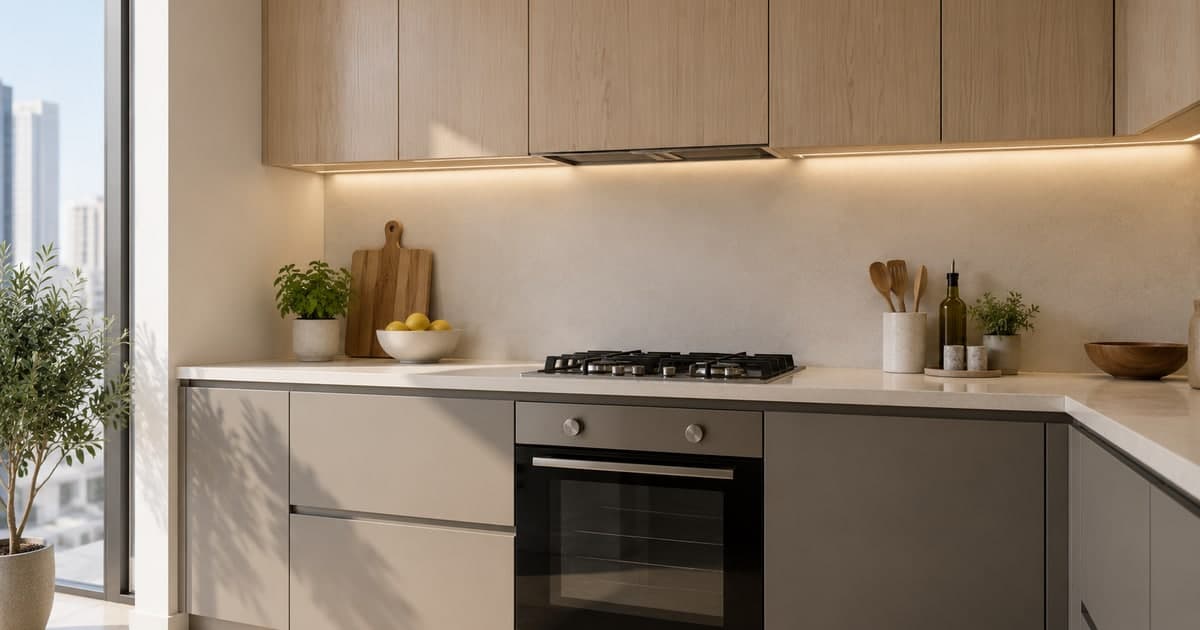
Under-cabinet lighting should illuminate the worktop where you prepare food, not simply create a glowing line beneath the cupboards. For an existing Dubai kitchen, the important choices are the usable lighting runs, glare, power supply, controls and access to replace components later. Buying the strip first can leave the most awkward parts of the installation unresolved.
Quick answer: specify the complete task-lighting system
- Identify the actual preparation areas and measure each separate cabinet run.
- Choose the light appearance and test reflections on your real worktop before fixing the layout.
- Include compatible drivers, connectors, profiles or diffusers and controls in the quote.
- Have fixed mains wiring and new electrical connections assessed by a qualified electrician; this is not a DIY wiring guide.
We have not established a consistent installed AED price range for this bespoke work. Retail light prices exclude different components and cannot be combined into a reliable labour-inclusive band. Request a written total for the agreed kitchen layout, with tax and exclusions shown. The light installation service is the relevant route; ceiling pendants and room-wide lighting are separate scopes.
Choose lighting around the task and cabinet layout
| Format | Useful when | Check before choosing |
|---|---|---|
| Continuous strip in a suitable profile | You want an even run across connected preparation areas | Diffuser appearance, cut/connection plan, mounting and driver compatibility |
| Rigid linkable bars | Cabinet widths suit defined light lengths | Dark gaps between bars, linking limits and all necessary cables |
| Individual puck lights | You need focused pools of light or have isolated small sections | Spacing, bright spots and shadows between fittings |
| Battery or rechargeable fitting | A small area needs occasional light without a fixed power connection | Charging access, runtime and whether output is enough for the intended task |
LEDVANCE’s under-cabinet overview distinguishes strips, bars and puck lights and highlights glare on reflective surfaces. That is a useful reason to ask for a sample, not to nominate one format for every home. A glossy dark worktop can show a distracting reflection even when the fitting itself is hidden by the cabinet lip.
Take a seated view from an adjacent dining area as well as the standing cooking position. Ask the provider to demonstrate the intended position and brightness before permanent fixing. Check that your body does not block the useful light while preparing food, and that long runs do not leave a dark section at a cabinet joint. Decorative plinth lighting is not a substitute for this worktop check.
Separate light quality from power consumption
Ask for the specified light output and colour temperature, not just watts per metre. Colour temperature affects whether the light appears warmer or cooler; colour rendering affects how objects look under it. Compare a sample against the existing ceiling lights, cabinet colour and backsplash. Avoid mixing visibly different white tones unless that is deliberate.
One current UAE product example illustrates the detail needed: the IKEA MITTLED 60 cm listing specifies 2700 K, CRI above 90, IP20, 480 lumens and 5.5 W. These are that model’s characteristics, not minimum requirements for your kitchen. Its 18 October 2026 advertised price was AED 89 including VAT for the light; the listed driver and required cords are separate. This is a product-only example, not a Bestimate price or installed estimate.
The example also explains why “dimmable” is incomplete without the control system. Ask which driver and dimmer work together, whether a hub is required for your chosen functions, and what happens if Wi-Fi is unavailable. A simple accessible switch may be sufficient; app control should solve an actual need rather than become an unpriced dependency.
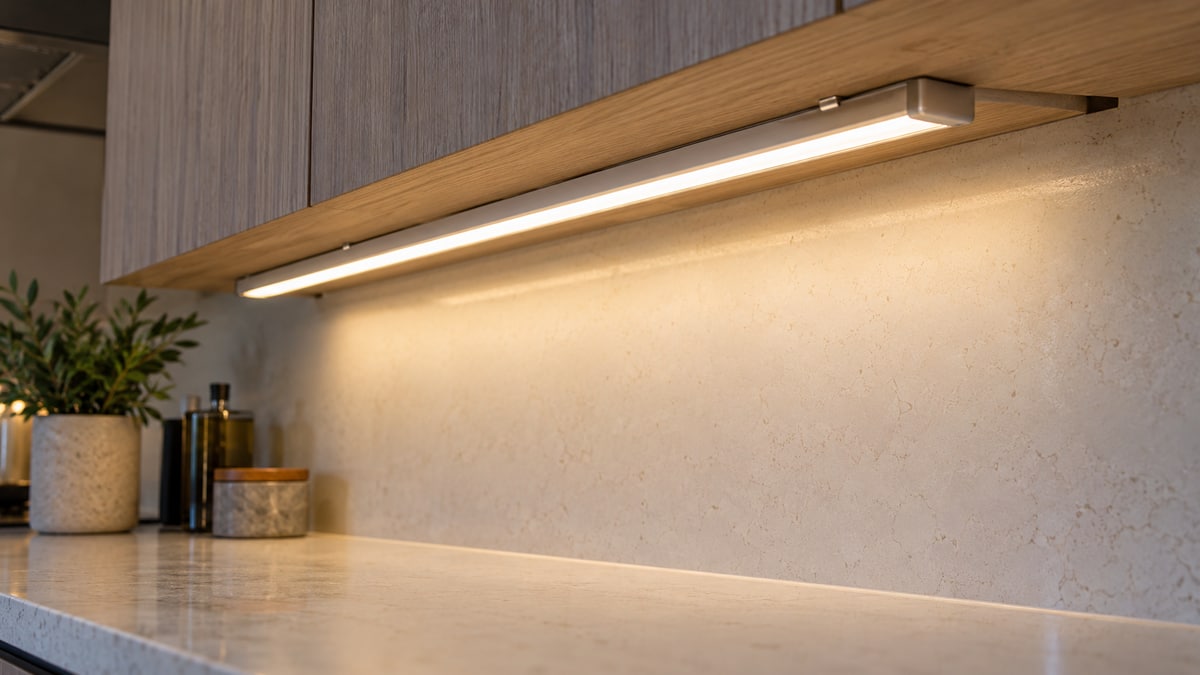
The hidden components deserve visible quote lines
Map the power source and cable route before installation. Separate cabinet-mounted low-voltage components from the fixed mains connection feeding them. A preconfigured plug-in product does not authorise altering a socket or making concealed mains connections yourself. If new fixed wiring is needed, ask a qualified electrician to assess it and confirm applicable requirements with building management where necessary.
Keep the driver accessible for inspection or replacement, subject to its manufacturer’s mounting and ventilation instructions. Ask whether changing a failed component would require removing a cabinet, cutting a finished panel or disturbing the backsplash. Do not conceal unknown connectors behind a permanently sealed finish just to make the quote look tidy.
Profiles and diffusers also need specification. LEDVANCE’s profile catalogue, for example, lists profiles, covers and matching accessory categories separately. It does not establish that any strip fits any channel. Ask the installer to identify the complete compatible assembly, its mounting method and the finish of visible ends. Product availability in another market is not evidence of UAE availability.
Compare the installed scope
| Quote area | Write down | Common gap |
|---|---|---|
| Light layout | Separate runs, actual lengths or bar counts, output and colour appearance | A metre rate applied to the whole kitchen perimeter |
| Power and controls | Exact drivers, connectors, switching and any required hub | Only the visible strip is priced |
| Fitting and cabinet work | Surface or recessed mounting, cable route, trims and finish repairs | Routing channels or drilling finished panels added later |
| Safety and serviceability | Suitability near heat/moisture, electrician scope and replacement access | A generic indoor product assumed suitable beside every hob or sink |
| Handover and aftercare | Control pairing, user instructions, component details and labour terms | Manufacturer product cover mistaken for installation callback cover |
Near a sink or hob, ask for a specific assessment of moisture, heat and clearance against the product instructions. An IP rating alone is not a kitchen-layout design. If the scope requires a new power point, the new socket installation guide helps separate that work. If cabinet changes are extensive, discuss them under the cabinet repair scope rather than hiding joinery inside a lighting allowance.
Compare your under-cabinet lighting quotes
Use the same light layout and control outcome for both proposals. The tool accepts your written costs for lights, power components, controls, installation and making good; it does not estimate brightness, electrical loads or market rates. Enter a kit once, not once per metre inside it. Keep unquoted wiring unknown and apply VAT only on the confirmed basis.
Compare a complete kitchen task-lighting installation, not an LED-strip price against a supplied, wired and tested system. Enter actual quoted amounts.
Open the full under-cabinet lighting quote comparison. Use written prices: unknown essentials remain unresolved and a comparable difference appears only after both scopes are confirmed.
What to send before the survey
Send a wide kitchen photograph, close views beneath each cabinet run, approximate lengths, the worktop and backsplash finishes, existing switches and sockets, and the places that currently feel dark. Show interruptions such as the hood, window, tall units and exposed shelving. State whether the property is occupied, whether drilling or routing is acceptable, and whether you want a switch, dimming or app control.
Before final payment, ask the installer to demonstrate every control, inspect glare from normal positions, check the agreed cable concealment and show where serviceable components sit. Keep model numbers, wiring documentation supplied by the electrician and warranty terms. Report flickering, unusual heat or burning smells promptly; stop using suspect equipment and seek qualified help rather than repeatedly resetting it.
Have your requirements ready? Compare under-cabinet lighting quotes with a free request, or check the matching service. Confirm the assessed scope and availability before booking.
Frequently asked questions
Can lighting be added without replacing the cabinets?
Often it can, but mounting space, wiring access and the power source determine the work. Surface-mounted bars or profiles may avoid routed recesses; ask what remains visible.
Is a price per metre enough to compare quotes?
No. Drivers, connections, controls, fitting and cabinet alterations can be separate. Compare the same completed layout and preserve each provider’s actual billing unit.
Should I choose warm or cool white?
Compare samples with the existing kitchen finishes and ceiling lights. The preferred appearance and useful task illumination matter more than a universal colour-temperature rule.
Can any LED strip use my existing dimmer?
Do not assume compatibility. The installer should verify the light, driver and dimmer as a system and confirm the expected dimming behaviour.
Will the driver be hidden permanently?
It can be discreet without becoming inaccessible. Agree a manufacturer-compliant location and a practical replacement route before cabinetry or finishes are closed.
Sources
Reviewed 18 October 2026: IKEA UAE MITTLED specification and product-only price, LEDVANCE lighting-format guidance and LEDVANCE profiles, covers and accessories. Overseas technical examples do not establish local stock, electrical suitability or installed charges. Confirm current product prices and exact project scope before ordering.